EVENT
Endeavor Greece at Panathēnea: When Athens Became a Meeting Point for Global Ambition
Endeavor Greece at Panathēnea: When Athens Became a Meeting Point for Global Ambition
For a few days in Athens, the question was no longer whether Greece has entrepreneurial momentum.
It does.
The more important question, the one Panathēnea 2026 actually answered, is what happens when that momentum meets real pressure. When world-class founders sit across from local builders. When global capital shares a room with Greek research institutions. When the Prime Minister and an AI founder have a conversation about national competitiveness in front of students who are deciding right now whether to build in Greece or leave.
What happens is that the ecosystem gets a chance to see itself at a different scale. Endeavor Greece has spent years making the case, quietly and persistently, that Greek founders can compete globally. Panathēnea was the moment that case got tested in public, at volume, across more than 20 activations over two and a half days, private dinners, founder meetings, roundtables, side events, and conversations that mattered not because of the stage they happened on, but because of who was in the room and what they were willing to say.
AI moved from trend to infrastructure
The most visible moment of the festival was also one of the most substantive.
Prime Minister Kyriakos Mitsotakis joined Mati Staniszewski of ElevenLabs and Panagiotis Karampinis on the Main Stage at Zappeion, and the conversation that followed went further than a partnership announcement. The real question on the table was harder: how does a country participate in the AI era not as a consumer of technology built elsewhere, but as an active contributor to how it gets built and deployed?
The MOU with ElevenLabs gave Greece a foothold in voice AI, a technology with direct, practical applications in public services, healthcare, tourism, language, and civil protection. But Mati's perspective grounded the moment in something more important than use cases. ElevenLabs started with a specific problem around voice, dubbing, and emotional expression. Today it sits at the center of a shift from screen-based interfaces to natural, emotionally intelligent interaction between humans and machines. The argument that AI will need not just IQ but EQ, the capacity to read tone, urgency, context, and human need, felt especially pointed in a country whose relationship with bureaucracy and public services has historically been defined by friction.
Later, at Hotel Grande Bretagne, the conversation became more concrete. Use cases emerged across urban development, healthcare, defence, pharma, and financial services from people who rarely sit in the same room. That is not something that gets engineered into an agenda. It is what happens when the right people are physically close to each other without an obvious reason to hold back.
Greeks building at the frontier
Ioannis Antonoglou and Anastasis Germanidis did not come to Athens to offer inspiration. They came to have a real conversation, and the ecosystem was better for it.
Ioannis's trajectory, from DeepMind to AlphaGo, AlphaZero, MuZero, Gemini, and now Reflection AI, represents the kind of technical depth that makes or breaks the next generation of AI infrastructure. His work on agentic systems and open models raises questions that go well beyond the startup world: who controls the infrastructure that AI runs on, and which countries and institutions have the ability to build their own? For Greece, these are not abstract questions. They are strategic ones.
Anastasis's work through Runway is doing something different but equally consequential. Generative video is not a feature in a content pipeline. It is a restructuring of how visual media gets made, who can make it, and what "creative production" even means at scale. The conversation his presence opened up in Athens was not about tools. It was about where Greece has real creative and technical depth to contribute.
Together, they made a useful point that did not get stated directly but ran underneath most of the sessions: Greece is not going to compete in the foundation model race. The compute, the capital, and the talent density required for that are concentrated elsewhere, and pretending otherwise serves no one. But there are places, AI applications, voice, generative media, life sciences, defence, specific verticals where Greek operators have domain expertise, where the opportunity is real. The question is whether the ecosystem can be honest about where it actually has an edge.
Venture capital, without the mythology
StrictlyVC Athens, co-hosted with TechCrunch and National Bank of Greece, is always one of the more useful events in the Athens calendar because it refuses to be polite. Connie Loizos does not let guests drift into abstraction, and the conversations with Ben Blume, Niko Bonatsos, Andreas Stavropoulos, Victoria Toli, Johannes Galatsanos, Anastasis Germanidis, Anatolii Kasianov, and Iliana Magra reflected that.
The through-line was simple and worth saying plainly: great companies are not built by accident, and they are not built by founders who think of their home market as a ceiling. Investors do not bet on potential. They bet on trajectory, on founders who have already started moving faster than the market around them, who are building for a problem large enough to matter beyond the geography they happen to be in.
At 100 Women in Tech, hosted by Sifted and Endeavor Greece, with Microsoft for Startups as strategic partner, the same conversation played out at a different scale. Founders building across pet insurance, e-commerce infrastructure, AI agents, voice biomarkers, and electronic medical records. Very different sectors, very different stages. The lesson that kept surfacing was the same one that tends to get underestimated by first-time founders: novelty is not a value proposition. The question is never whether a technology is interesting. It is whether someone needs it urgently enough to pay for it, and whether the team building it can get to them before someone else does.
Innovation without the quotation marks
One of the better decisions Endeavor made for Panathēnea was refusing to let "innovation" mean only venture-backed software startups.
The Real Economy Leadership Stories panels brought a different kind of company to the conversation, family businesses, consumer brands, manufacturers, operators. Thomas Douzis of ERGON FOODS, Achilleas Aggelopoulos of KYKNOS CANNING, Anna Maria Mazaraki, Dimitris Kolettas of Attrattivo. Companies that have spent decades building something people actually use, in categories that are harder and less glamorous than the ones that fill tech conference agendas.
The second panel, Yorgos Trakakis of ENDLESS EC, Armodios Yannidis of VITEX, Thodoris Skagias of SKAG, was a conversation about succession and transformation. What does it mean to take over a business that was built by someone else, in a different era, under different conditions, and decide what it becomes next?
This is not a peripheral question for Greece. The country's economic backbone is built on these companies. And the future of the startup ecosystem is not separable from them, not because startups need to look more like family businesses, but because family businesses are the first real market for most of what Greek founders build. If those companies do not adopt technology, do not internationalize, do not prepare the next generation of leadership to think at a global scale, then the ecosystem has a market problem no amount of venture capital can solve.
Life sciences, defence, and the advantage of local depth
Two sectors stood out at Panathēnea as places where Greece is not simply following a global trend but has something specific and defensible to contribute.
At Athens Life Sciences Day, nearly 270 attendees gathered for conversations that spanned venture building, AI-native drug discovery, medical devices, and clinical innovation. The energy was not aspirational. It was technical, specific, and grounded in actual work. Life sciences is one of the sectors where being small and focused is not a disadvantage, where a research institution with a specific capability, connected to the right investor at the right moment, can move faster than a large organisation with a broader mandate.
The LifeHack Athens hackathon produced ideas around AI-powered clinical decision support, RNA therapeutic design, and secure medical data analysis. These are not soft ideas. They are the kind of ideas that require scientific training, domain knowledge, and the ability to think about problems that take years to solve. That is exactly the kind of talent Greece has been producing, and losing, for a long time. If the ecosystem can retain more of it, or bring some of it back, life sciences is one of the areas where the return on that investment compounds quickly.
Defence innovation is harder to talk about in a festival context, but the conversation at Innovation on the Frontlines, held at Amalias 36, was one of the more grounded discussions of the festival. Government, Armed Forces leaders, Military Academies, startups, investors, and members of the Greek diaspora in a room where everyone understood the stakes, because for Greece, defence technology is inseparable from geography and sovereignty. Unmanned systems, AI, interoperability, testing environments, procurement pathways. The problem is not whether Greece has founders capable of building in this space. The problem is whether the institutional machinery around them, capital, procurement, testing, deployment, can move fast enough for the technology to matter.
What the booth actually meant
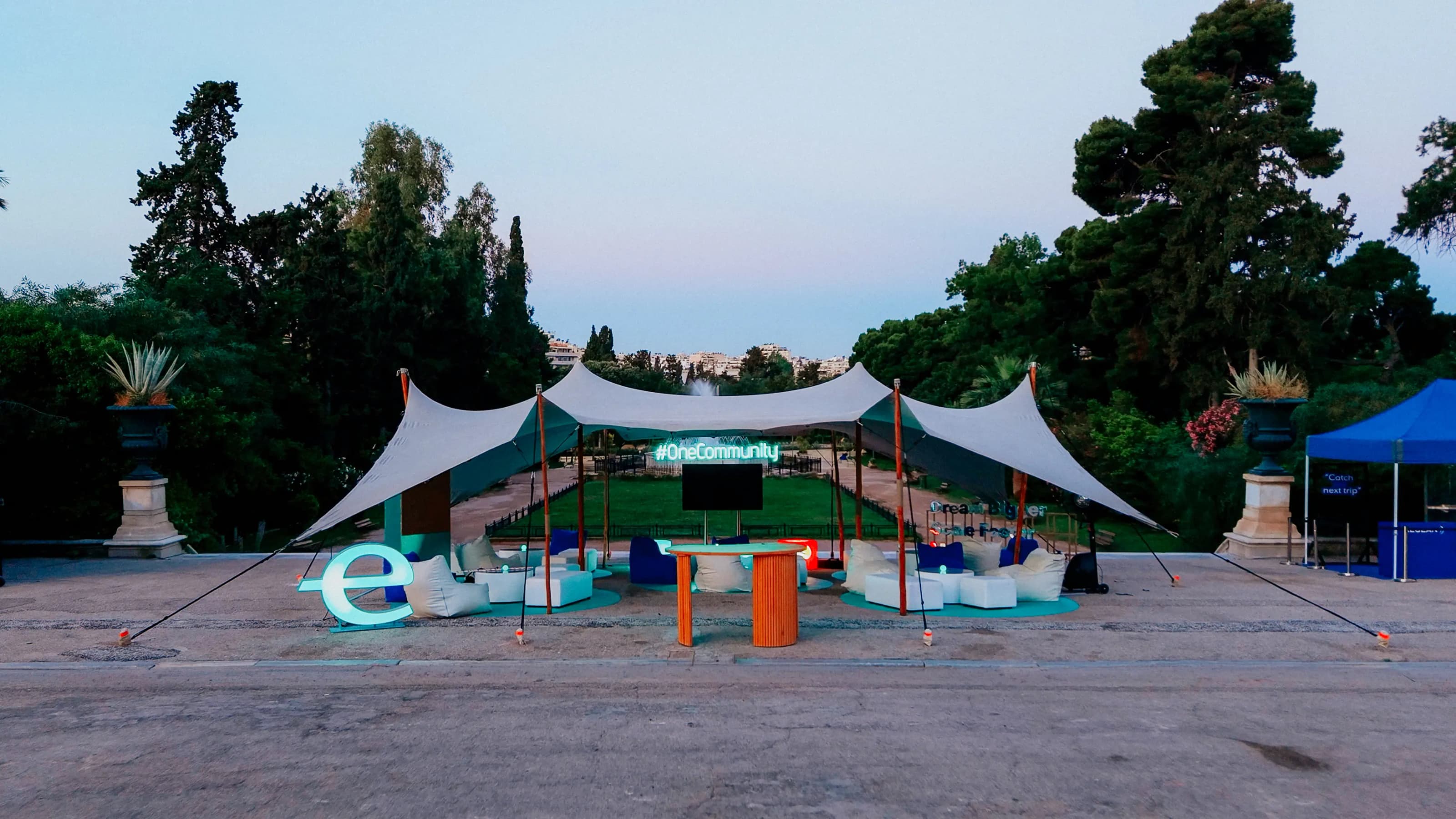
Some of the most important moments of the festival happened not on stage but at the Endeavor booth at the heart of Zappeion.
This is worth saying plainly: a booth is usually a liability. It is something you stand next to and feel slightly awkward about while people walk past. The Endeavor booth at Panathēnea was different. It became a meeting point, somewhere founders, investors, students, operators, and media came through to work, to rest, to continue conversations that had started in sessions. The roses in Endeavor's colors were a small gesture that generated an unexpected amount of organic video content. That is a useful reminder: warmth and hospitality are not soft values. They are strategic ones. People remember how a place made them feel long after they have forgotten what was said on stage.
By night, the same space became the VIP area for the Panathēnea x Endeavor closing street party in front of Zappeion, Delphine, Lil Koni, and Agents of Time on the lineup, the city showing up around something that was built for the community. Innovation ecosystems are not only built in conference rooms. They are built when a city is willing to celebrate what it is becoming.
The real measure
Panagiotis Karampinis said something at the festival that has stayed with us: one of Greece's biggest challenges has been that the younger generation feels disconnected from what is happening globally. At Panathēnea, that changed. Not because of a panel or an announcement, but because a 22-year-old in Athens could watch Ioannis Antonoglou talk about the systems he built at DeepMind and understand, for the first time, that the frontier is not only somewhere else. It is also here, and it is reachable.
TechCrunch, Sifted, and Bloomberg were part of the conversation. International founders came to Athens not as a courtesy stop but because the quality of the people in the room made it worth being here. That is a different signal than it might look like. International media and founders do not show up to ecosystems out of generosity. They show up when the network density justifies it.
The most important measure of Panathēnea will not be the number of panels or posts or attendees. It will be the introductions that turned into partnerships, the founders who followed up, the investors who took a closer look, the students who decided to build.
That is Endeavor's actual role, not to celebrate the ecosystem, but to create the conditions that make ambition more actionable. Access, trust, capital, mentorship, a global network that helps companies scale beyond the market immediately around them.
Panathēnea made that role visible. The work now is to make it permanent.