EVENT
Europe's Next Generation of Builders | Lessons from 100 Women in Tech Athens
Europe's Next Generation of Builders
Lessons from 100 Women in Tech Athens
For years, the conversation around European startups often revolved around a single question: can Europe produce globally relevant companies?
Today, the more interesting question is something else entirely. How do you build more of them?
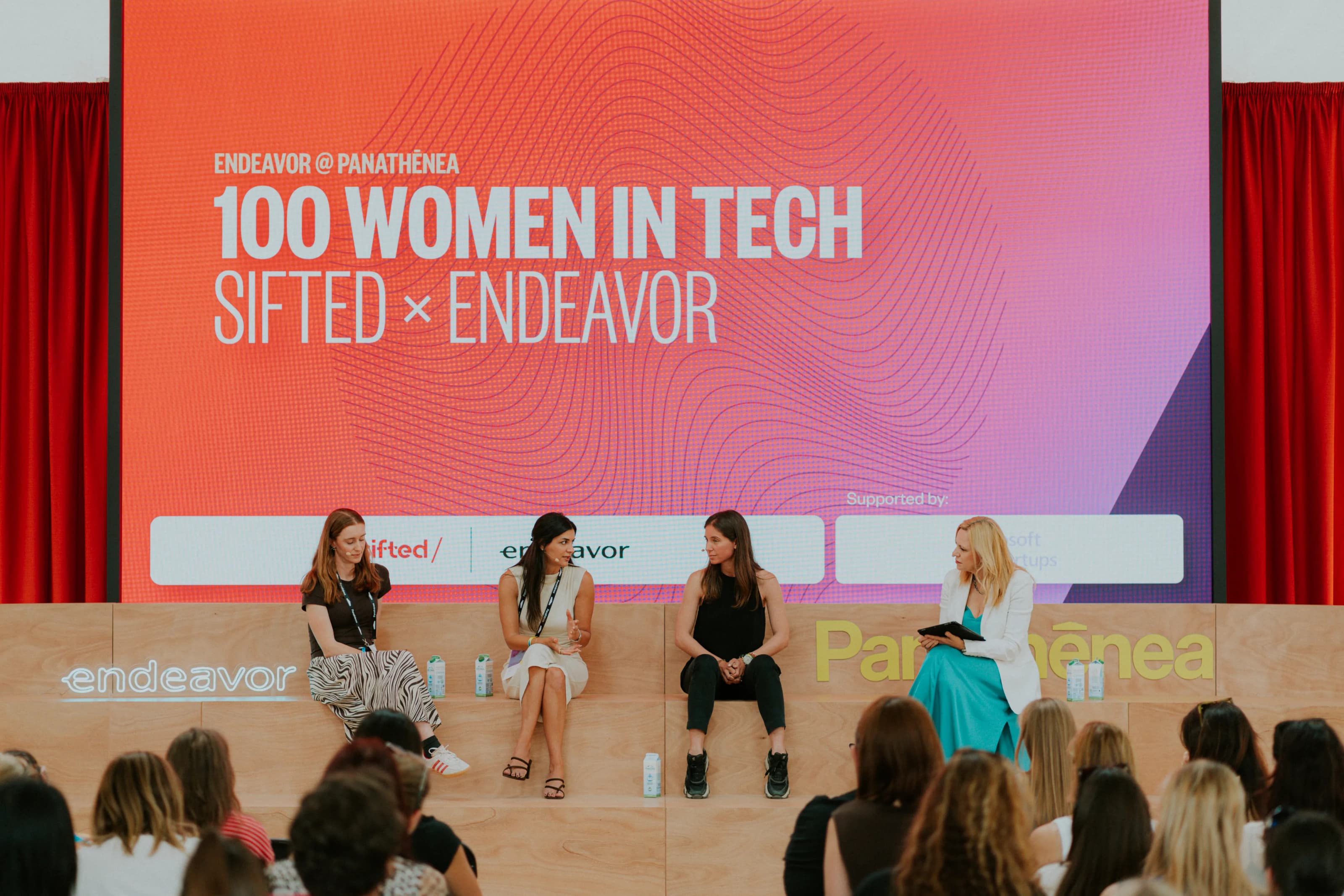
That question sat at the center of the first-ever 100 Women in Tech event in Athens, a curated Panathēnea 2026 side event hosted by Sifted and Endeavor Greece, with Microsoft for Startups as strategic partner. On a warm afternoon at Aigli Cinema in Zappeion, three panels brought together founders building across pet insurance, AI agents, e-commerce infrastructure, voice biomarkers, and electronic medical records. Different sectors, different stages, different geographies. Yet the conversations kept circling back to the same handful of convictions: focus relentlessly, start with the problem not the technology, and build for a market much larger than the one immediately around you.
Europe Is Not the Limitation
The afternoon opened with Hedda Båverud Olsson, Co-Founder and CEO of Lassie, in conversation with Freya Pratty, Associate Editor at Sifted. Lassie has become one of Europe's fastest-growing pet insurance companies, surpassing €100 million in annual recurring revenue with a team of almost exactly 100 people , a metric Hedda noted with visible pride: €1 million per employee. The company launched first in Sweden, expanded to Germany despite being repeatedly warned it would be too difficult, and is now present in France, with Germany as its biggest market.
The choice to go big early was deliberate. "We decided we wanted to conquer the world," Hedda said, "and with that we knew it was going to be a lot faster with VC capital." Within the EU, she explained, the administrative burden of launching in a large market is roughly the same as launching in a smaller one , so the question becomes: why not go where the opportunity is bigger? Germany was the answer.
Growth, she argued, rarely comes from doing more things. It comes from doing fewer with greater conviction. The company's biggest stumble came when, just before a fundraising round, they tried to launch an e-commerce side project alongside their core business. "We didn't invest enough time. It was a side thing." The lesson stuck: one or two clear goals, communicated to the whole company, executed without distraction. "If you have one clear goal , succeeding in Germany , just spell it out to the whole company and go all in."
Her vision for what Lassie becomes next drew a clear line to Revolut: a super app, but for pet health. Insurance is the wedge. Trackers, personalized nutrition, premium subscriptions , the ecosystem deepens from there.
AI Is Not the Product
The second panel, moderated by Myladie Stoumbou, Regional General Manager at Microsoft and Board Member, brought together three founders operating at the intersection of AI and scale: Philippa Brown, Founder and Co-CEO of Elyos AI; Rania Lamprou, Co-Founder and CEO of Simpler; and Alex Loi, Co-Founder of Wayfor.
Despite operating in very different sectors, all three described the same founding instinct: start with a problem, then find the technology. Not the other way around. Rania was direct about it: "Don't build technology and then search for a problem." Her own company, Simpler, was born in lockdown, not from a vision for AI infrastructure, but from the personal frustration of trying to check out as a shopper across Europe's fragmented e-commerce landscape. Twenty-seven markets, twenty-seven sets of payment behaviors, twenty-seven different consumer expectations. Most founders see that as complexity. Rania sees it as a moat. "Think global, act local," she said , and the more complex the market, the harder it becomes for anyone else to follow. Simpler recently raised €9 million, with their investors approaching them first , and Rania was candid about what has shifted for women founders in fundraising: "Now everyone is asked to show real numbers. Before, it was only something women had to do. Now it's a fact for everyone."
Philippa, meanwhile, is building AI agents for the people who keep the real world running: plumbers, electricians, field engineers. It is a common assumption, Myladie noted in framing the conversation, that industries like field services are resistant to AI adoption. Philippa pushed back immediately: the managing directors and CEOs of these businesses want to see growth, and if an AI agent can deliver that ROI, they are ready to listen. She trained as an electrician herself before launching Elyos AI, and that experience shapes everything about how the company sells. "Deeply understand customer pain points. Pitch solutions to those pain points, not just sexy AI products." Building technology is no longer the hard part. Creating meaningful value is.
Alex brought a different angle to the same question. Wayfor works with companies trying to embed learning , particularly around AI , into the way people actually do their jobs, rather than layering it on top as another obligation. The distinction she drew was precise: "Instead of saying learning, if you say transforming, something works better , because it has to be every single person's priority." The measure of success is not completion rates or click-throughs. It is whether technology actually changes how someone works. Adoption, not compliance.
Myladie closed the panel with a reflection drawn from thirty years in the industry that landed with particular weight in a room full of founders: "Be a builder. Be a learner. Be a leader." The last point, she added, applies even to solo founders , because in an era of AI agents, every founder is already leading a team, whether they think of it that way or not.
When Deeptech Meets Reality
The final panel, again moderated by Freya Pratty, shifted to the longer horizon: companies where the distance between breakthrough research and real-world adoption is measured in years, not months. The two founders on stage , Emilia Molimpakis of Thymia and Eirini Schlosser of Dyania Health , have both spent those years doing something most people wouldn't attempt: building frontier technology in healthcare, one of the most demanding, slowest-moving, and highest-stakes industries in the world.
Emilia, Co-Founder and CEO of Thymia, is a neuroscientist who spent twelve years as a researcher before turning her specialty , language , into a company. Thymia builds voice biomarkers: through just 15 seconds of speech, the technology can assess stress, fatigue, burnout, depression, anxiety, and even detect active type 2 diabetes. Underpinning it is what is now the world's largest multimodal dataset of its kind, close to 100,000 unique voices captured alongside blood biomarkers, EEG data, and wearable device readings. The company started by targeting healthcare directly, but the market wasn't ready. So it followed the pull , into safety-critical environments like construction, automotive, and mining, where monitoring fatigue saves lives, and more recently into the voice AI industry, where telcos and edtech companies upsell Thymia's biomarkers alongside their own products. One application Emilia hadn't anticipated: coaching neurodivergent people with autism on social cues through a dating app. "If you'd asked me a year ago, I would never have thought of that use case." The lesson wasn't about pivoting. It was about listening to where the market pulls you, and being willing to go.
Eirini Schlosser, Founder and CEO of Dyania Health, is solving a problem that sounds deceptively simple: reading electronic medical records. In practice, it is one of the most complex and high-impact challenges in healthcare. Dyania automates the extraction of clinical signals from patient records and brings them to physicians at the point of care, helping healthcare teams identify patients who may otherwise be missed, flag high-risk cases earlier, and route them toward the right treatment. Her go-to-market philosophy was characteristically bold: start with the hardest, most demanding customers first. For Dyania, that meant working with leading healthcare systems from the beginning, not because it was the easiest path, but because it was the one that could prove the technology where the stakes were highest. Every challenge the company faced in those early years, she explained, has now become part of its moat. In a field where trust, validation, and integration matter as much as the technology itself, Dyania’s advantage is not only what it has built, but where it has already been tested.
What both founders made clear is that deeptech scaling is a different discipline entirely. It requires patience that most startup playbooks don't account for, a willingness to do the hard technical work long before there is any commercial reward, and the ability to find partners , not just customers , who are willing to test something genuinely new. Emilia put it plainly: "Novelty is commoditized. Everybody can build something new. It's not about the novelty. It's about whether it creates value for someone." Eirini's version of the same idea was more visceral: every challenge they overcame in those early years of "eating glass," as she called it, is now a moat. New competitors entering the space today are still in co-development. Dyania is already in hospitals.
By the time the afternoon wrapped, the room had stayed long past when it was supposed to empty. The conversations continued at the tables, in the corridor, outside in the early summer heat.
Europe is not lacking talent, or ideas, or ambition. The challenge , and the opportunity , is creating more founders willing to think past local markets, more companies capable of scaling without a template, and more afternoons like this one: where the question is no longer whether it can be done, but how many more times.