EVENT
From Digital Progress to National Readiness
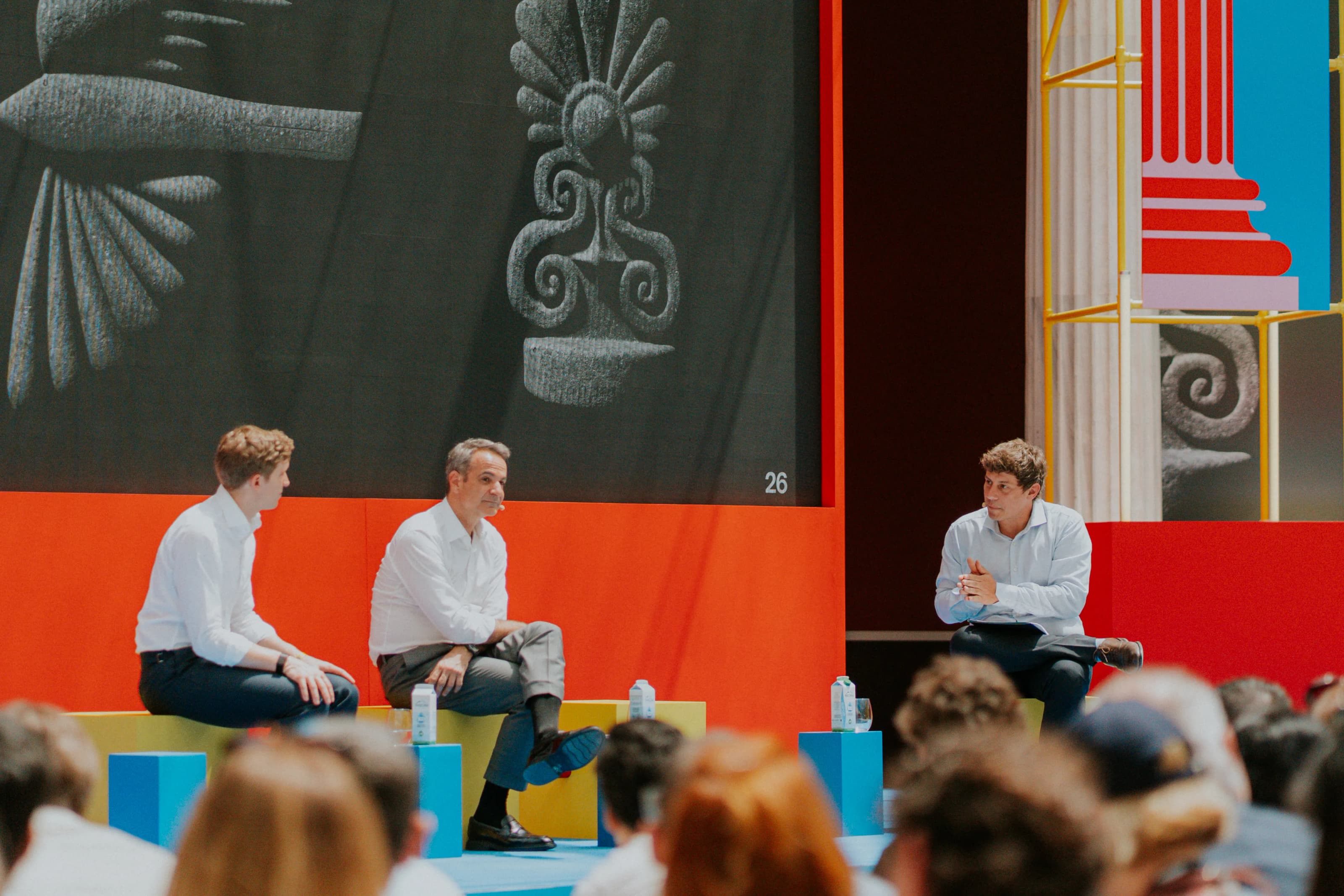
Greece’s AI Moment: From Digital Progress to National Readiness
At Panathēnea 2026, the conversation around artificial intelligence moved beyond technology and into something much bigger: how a country prepares for a new era.
On the Main Stage, Prime Minister Kyriakos Mitsotakis, Mati Staniszewski, Co-founder & CEO of ElevenLabs, and Panagiotis Karampinis opened a discussion on AI, public services, national competitiveness, Europe’s position in the global technology race, and the responsibility that comes with building and adopting technology at this scale.
The starting point was Greece’s new partnership with ElevenLabs. But the conversation quickly became broader. It was not only about voice AI, or one agreement, or one use case. It was about how Greece can use AI practically, responsibly, and strategically across government, infrastructure, public services, tourism, culture, healthcare, defence, and civil protection.
A Partnership That Signals a Broader Shift
The conversation began with the announcement of Greece’s partnership with ElevenLabs, one of the world’s leading voice AI companies. The ambition is clear: to explore how voice AI can be integrated into public services through gov.gr, allowing citizens to interact with the state not only by typing, but through natural conversation.
This matters because the next phase of digital government is not just about moving services online. Greece has already made significant progress there. The next question is how public services can become more accessible, intuitive, and human-centered.
A voice-enabled gov.gr experience could make a meaningful difference for people who may struggle with forms, bureaucracy, or complex digital processes. As the Prime Minister described, imagine an older citizen trying to navigate the pension system and being able to speak to a “smart and friendly AI agent” that can guide them through the process.
The partnership also extends beyond government services. Tourism promotion and the preservation of Greek linguistic dialects were both mentioned as potential areas where voice AI could create value. The example of the Cretan dialect was especially interesting, because it points to a different side of AI: not just efficiency, but cultural preservation.
In that sense, the partnership is not only a technology announcement. It is a signal of how Greece wants to position itself in the AI era: as a country willing to experiment, adopt, and apply emerging technologies to areas where they can have practical and cultural impact.
From Digital Transformation to a “New Operating System” for Government
One of the most important points of the discussion was the idea that Greece’s digital transformation is entering a new phase.
The Prime Minister referred to Greece in 2019 as a “technological laggard”, describing a state still weighed down by bureaucracy, poor public-service delivery, and difficult interactions between citizens and government. Since then, gov.gr has become one of the clearest examples of how digital transformation can improve the relationship between people and the state.
But AI changes the level of ambition.
According to the Prime Minister, the opportunity now is not simply to add AI on top of existing systems. It is to rethink the way the government operates. He described this as the need for a “new operating system” for government , a complete rethink of processes, data management, infrastructure, regulation, and citizen experience.
That framing is important because it moves the conversation beyond tools.
AI in government is not just about chatbots or automation. It is about whether the state can become more productive, more responsive, and better designed around the needs of citizens. It also raises important questions about data quality, open data, regulatory sandboxes, and the ability of public institutions to work with innovative companies in a faster and smarter way.
This is where Greece’s AI strategy becomes more than a public-sector project. It becomes a national competitiveness issue.
The Founder’s Perspective: From Voice to Emotion
Mati Staniszewski brought a different but equally important perspective to the stage: that of a founder building one of Europe’s fastest-growing AI companies.
ElevenLabs began with a very specific problem. In Poland, foreign films were often dubbed by a single narrator, without emotion, nuance, or distinction between characters. That frustrating experience became the starting point for a much larger mission: to make communication between humans and technology more natural, expressive, and emotionally intelligent.
What began as a voice problem became a broader question about how humans will interact with AI.
Mati explained that ElevenLabs’ early focus was on creating human-like voice models that could understand context, convey intonation, and bring emotion into narration. Over time, the company moved from static audio generation to interactive voice experiences, where users can actually speak with AI agents.
One of the most powerful ideas he shared was that the next frontier is not only IQ, but EQ.
In other words, the future of AI will not be judged only by how intelligent it is, but by how well it understands people. Can it recognize stress? Can it slow down when someone needs more time? Can it respond with reassurance when a user is frustrated? Can it communicate in a way that feels useful, trustworthy, and emotionally aware?
That point connects directly with public services. If AI is going to become part of how citizens interact with the state, then the quality of that interaction matters deeply. It cannot only be technically correct. It has to be understandable, accessible, and responsible.
Greece’s AI Bets: Public Services, Infrastructure, and Strategic Verticals
The discussion also made clear that Greece’s AI strategy is not limited to one partnership or one use case.
The Prime Minister outlined several priority areas where Greece can move faster and build meaningful advantage.
The first is public services: using AI responsibly to make government interactions simpler, faster, and more user-friendly.
The second is sovereign AI infrastructure. Greece is investing in infrastructure such as the Daedalus supercomputer in Lavrio and exploring larger data infrastructure projects that could connect the country to Europe’s broader sovereign AI ambitions.
The third is strategic verticals where Greece can apply AI in ways that are both nationally relevant and globally exportable. Healthcare was one of them, with the potential to work with startups and high-quality datasets to develop solutions that can scale beyond Greece. Defense was another, especially as AI reshapes the battlefield and creates opportunities for faster prototyping and collaboration with startups. Civil protection was also highlighted, with AI use cases around weather prediction, flood management, and fire management.
These areas matter because they show a more mature understanding of AI adoption. The goal is not to use AI everywhere for the sake of it. The goal is to identify where Greece has real needs, real data, real talent, and the ability to develop solutions that could also travel beyond the country.
Europe’s Challenge: Building From Europe, For the World
The conversation naturally moved from Greece to Europe.
Mati made a distinction that felt especially relevant: building from Europe and building for Europe are not the same thing. Europe has the talent to build globally competitive AI companies, but the ambition must be global from the beginning.
This is one of the central challenges for the European innovation ecosystem. Europe has extraordinary technical talent, strong research, and a deep industrial base. But it still faces structural barriers around capital, regulation, and market fragmentation.
The Prime Minister pointed to the need for Europe to mobilize more private capital through initiatives such as the Savings and Investment Union, so that fast-growing European companies are not forced to rely almost entirely on US venture capital or US public markets. He also emphasized the importance of the “28th regime”, a proposed EU-wide legal framework that could make it easier for startups to operate across member states without unnecessary bureaucracy.
At the same time, the discussion did not treat regulation as the enemy of innovation. The point was more nuanced: Europe needs smarter regulation. It should avoid creating complexity that slows companies down, while still being firm in areas where the risks are real , especially when it comes to children, teenagers, mental health, AI companions, and the social consequences of new technologies.
That balance may become one of Europe’s most important advantages if it gets it right.
The Responsibility Behind the Technology
Perhaps the most important part of the conversation came toward the end, when the discussion shifted from opportunity to responsibility.
AI will create enormous productivity gains, but it will also disrupt the labor market. The Prime Minister was clear that policymakers cannot ignore this. If the benefits of AI are seen as accumulating only to companies, capital, or large technology players, there is a risk of social backlash.
That is why the transition matters.
The question is not only how fast we can adopt AI, but how well we can prepare people for the changes it will bring. Education, reskilling, workforce readiness, and social responsibility will all become central parts of the AI conversation.
Mati’s view was more optimistic, but aligned with the same principle. He expressed the hope that AI will amplify human potential rather than replace it, allowing technology to operate more on human terms instead of forcing people to adapt to the language of machines.
That may be the real promise of this new era: not simply more powerful technology, but technology that becomes more natural, more accessible, and more aligned with the way people actually think, speak, work, and create.
Why This Stage Mattered
What made this conversation powerful was not only who was on stage. It was where it happened and who was in the audience.
Panathēnea is a student-run, non-profit tech festival. It brings together the next generation of builders, founders, engineers, operators, researchers, and ecosystem leaders. Hosting this conversation there gave it a different meaning.
Because the people listening were not just passive observers of the AI era. They are the people who will be asked to build its companies, design its products, regulate its risks, question its assumptions, and live with its consequences.
That is why bringing this discussion from India to Athens mattered.
It connected a global AI founder, the leader of a country actively investing in digital transformation, and a new generation of Greek talent in the same room. It turned an idea into a public conversation, and a public conversation into a signal about where Greece wants to go next.
The conclusion was not that Greece has already solved the AI challenge. No country has.
But the message was clear: Greece is no longer watching the AI race from the sidelines. It is choosing to participate, to build, to regulate smartly, to attract talent, to invest in infrastructure, and to bring global technology leaders into its transformation journey.
And perhaps that is how ecosystems really move forward.
Not through one announcement or one panel, but through the right conversations happening at the right time, in front of the people who are ready to turn them into action.