EVENT
Lessons from the ElevenLabs Roundtable at Panathēnea
Lessons from the ElevenLabs Roundtable at Panathēnea
In late May, the Greek Prime Minister signed an official MOU with ElevenLabs at Maximos Mansion, the first formal agreement between the company and a national government. The deal covers voice integration across Greece’s 2,200 digital public services, tourism applications through VisitGreece, and a pilot digital library of regional dialects built with the Athena Research Centre and the Institute for Language and Speech Processing.
The Prime Minister framed it simply: “We should not approach AI with fear and passivity. We are open to partnering with innovative companies to help them test their models in a national context.”
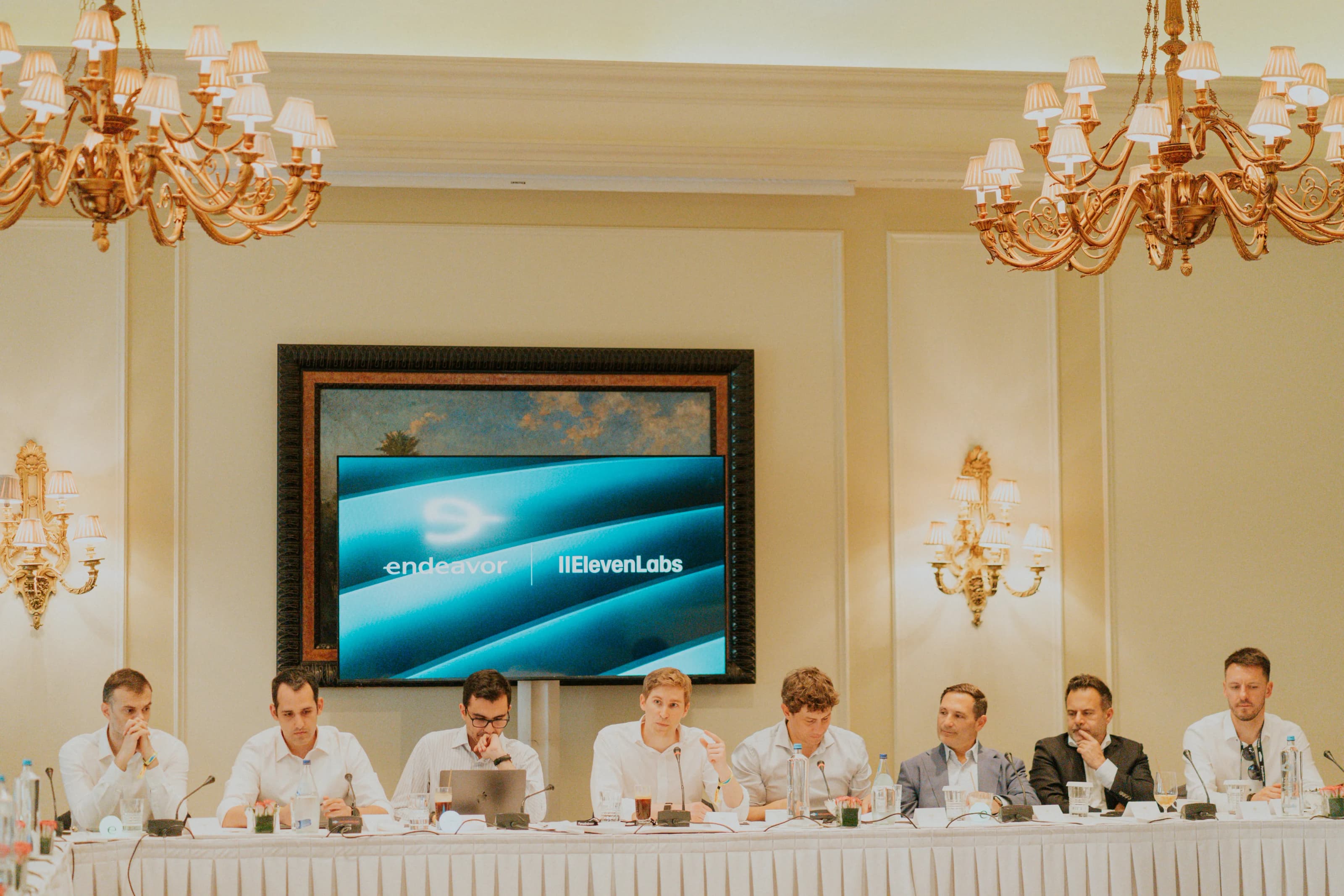
The same afternoon, Endeavor Greece brought ElevenLabs Co-founder Mati Staniszewski to Hotel Grande Bretagne for a roundtable hosted by Panagiotis Karampinis, with founders, executives, investors, and operators from across the Greek ecosystem. The MOU was the starting point for a more uncomfortable conversation about what Greece, and Europe, actually needs to do differently.
Voice as infrastructure, not feature
Mati has been making the same argument for three years. It is only recently that people have started to believe him.
“In the past, audio was fit for purpose for giving good narration. But for a long time you couldn’t really interact with it in a way that’s seamless, it wasn’t reliable, and it was hard to deploy, evaluate, and manage. Over the last few months, all three of those things have finally been fixed.”
The result: ElevenLabs crossed $500M in ARR this year, more than doubling from $200M within twelve months. The company is profitable and counts 75% of Fortune 500 companies among its customers. Greece has been part of the story from the beginning, with one of the country’s leading media organizations among the company’s first enterprise customers in 2023, and Greeks leading both research engineering and field deployment inside ElevenLabs today.
The vision Mati described goes well beyond narration or customer support. Three shifts, in his framing: all content becoming available in audio by default; the language barrier breaking down entirely; and voice becoming the primary interface for the technology around us.
“Today it’s digital screens. In the future it will be devices around us, and in the longer future, humanoids. But to solve that, we need to solve how speech can be seamless in the interaction you’re having with it.”
The emotional intelligence layer is where ElevenLabs is investing heavily right now. If someone calling in is stressed, the agent should be able to respond calmly. If someone wants to speak more slowly, the agent should adapt. The goal, as Mati described it, is eventually passing the Turing test not only in customer support, where he believes ElevenLabs is close, but across any interaction.
The government deal is a message to the private sector
Vasilis Koutsoumpas, Digital Policy and AI Adviser at the Office of the Prime Minister of Greece, who structured the ElevenLabs partnership, was direct about what the MOU was and wasn’t: “The biggest revenue stream is not going to be the government work. It’s going to be the use cases you find with them, how you work together. If the government has found a way to work with a big tech company, so can you.”
The private sector in the room got the message, but the conversation quickly turned to why acting on it is harder than it sounds.
Mati described the pattern he has seen repeatedly: “A lot of our early customers were US customers. They were more keen to take the risk and bet on a small company, at the time with five people. It took much longer to get the same in Europe.”
That gap is not just cultural. It compounds. Early customers provide learning, credibility, and product feedback that allow companies to move faster and attract the next customer. When large organizations wait for proof, they do not only protect themselves. They also slow down the ecosystem around them.
“Being able to do a case study, or a test, or build a logo, that’s such an incredible piece, but it helps with that whole cycle.”
Europe’s actual structural problem
The roundtable surfaced something more persistent than risk aversion: Europe still does not function as a single market, and the cost of that fragmentation becomes especially visible in fast-moving technology sectors.
“When you hire people in Europe, most countries will take three months’ notice. In the US it usually takes a month or shorter. And if you need to sign contracts, the legal resources required are going to be so different.”
Three months of hiring lag does not sound dramatic until a company is trying to move at the speed that AI currently demands.
The talent pipeline compounds it. “There are fewer companies that have made it to a billion in Europe, and even fewer to ten billion. What that means is that the people who have seen a company grow and watched the structure break, who know how to build a go-to-market team, a marketing team, there’s just a smaller supply of them.”
ElevenLabs’ response has been to bring experienced people in from other ecosystems, treating that knowledge transfer as a competitive advantage. The broader implication is that every European company that scales creates institutional memory the whole ecosystem benefits from.
Mati’s ask of the people in the room was specific: a true 28-regime single digital market, a shift in corporate risk appetite, and more proof-of-value stories made public.
“Not proof of concept, proof of value. You can now build a prototype that shows the actual results. More of those stories will definitely help.”
The use cases that came out of the room
The most valuable part of the evening was not the prepared remarks. It was the Q&A, which brought perspectives from sectors that rarely sit together.
From urban development, the discussion turned to where voice AI could create the most transformative use cases for city life. The answers covered a broad spectrum: immersive cultural guides for visitors, AI assistance for blue-collar workers on construction sites who cannot access screens, emergency services coordination, and in-car AI assistants for a city that remains heavily car-dependent. ElevenLabs also noted that the company is looking for office space, opening an interesting bridge between physical infrastructure and AI deployment.
From healthcare, the conversation went deeper than appointment booking. The discussion focused on the real technical challenge: orchestrating multiple data streams in real time, handling background noise and interruptions without losing the thread, and deciding what should run on-device versus in the cloud.
ElevenLabs’ research team addressed the noise problem directly, explaining that the latest models can distinguish between speech and other sounds, detect the primary speaker, and ignore background interruptions.
The conversation also touched on full duplex: the ability for an AI agent to interrupt, respond, and continue a conversation while a human is still speaking. Mati explained that companion-type use cases could move faster, while enterprise applications will take longer because the tradeoff is more complex. Full duplex can make the interaction feel more natural, but it can also reduce control and observability over the intelligence layer, especially when enterprise partners want the flexibility to switch between different model providers.
From defense, the discussion moved to co-development for edge AI in internet-denied environments. Mati’s response was direct: “You have expertise we definitely don’t have. To do it well, you need to partner extremely closely.” He also noted that ElevenLabs is very careful about certain international partnerships in edge development, a constraint that makes European defense-adjacent partners more strategically relevant.
From pharma, the conversation moved to enterprise deployment and the possibility of exploring voice AI for large salesforces visiting doctors and pharmacists. ElevenLabs’ team also confirmed that Greek enterprise adoption, while still early, is already moving, with a Greek-language banking voice agent expected to launch in June.
What Greece offers that is actually valuable
The honest version of the Greece opportunity is not that Athens will suddenly become Europe’s next AI hub. It is that Greece can offer something equally valuable: high-context deployment environments in sectors where the country has genuine depth and where the right people can still be in the same room.
Tourism at scale. A public services infrastructure that already reaches every citizen. Healthcare with a strong public network. Shipping and maritime with decades of operational knowledge. Defense and dual-use technology that is suddenly globally relevant. Urban development projects large enough to become test beds for entirely new models of how cities work.
One of the country’s major urban development projects alone, with residential, commercial, healthcare, education, and mixed-use infrastructure, could become one of the few places in Europe where voice-first infrastructure is designed from the beginning rather than retrofitted onto existing systems.
What the roundtable showed is that the people who could actually make these use cases happen were all in the same room.
The question is whether that proximity becomes deployment before the moment passes.