EVENT
Athens Innovation Summit by Endeavor 2026

When :
02 / 10 / 2024
6:00 AM - 1:30 PM
Impossible was closer than we thought
Athens Innovation Summit 2026 - AI, power, and the case for building elsewhere
They had a plan to game their economics class: build something so complicated the professor would just hand them top marks rather than wade into the details. It backfired. Their professor - Mike Lyons at Stanford - read the idea, decided it made sense, and offered them a grant to chase it. "He helped us understand that impossible was way closer to possible than we'd thought," Rafał Modrzewski told the room. "We were trying to trick them - and yet they tricked us back."
That student project became ICEYE, which today runs the world's largest synthetic aperture radar constellation - satellites that see through cloud and darkness, down to 25cm. On Thursday evening, its co-founder and CEO told that story on the Pnyx: the Athens hill where, 2,500 years ago, citizens first decided that ordinary people - not a king or a pharaoh - should shape their own future.
A hill built for deciding the future
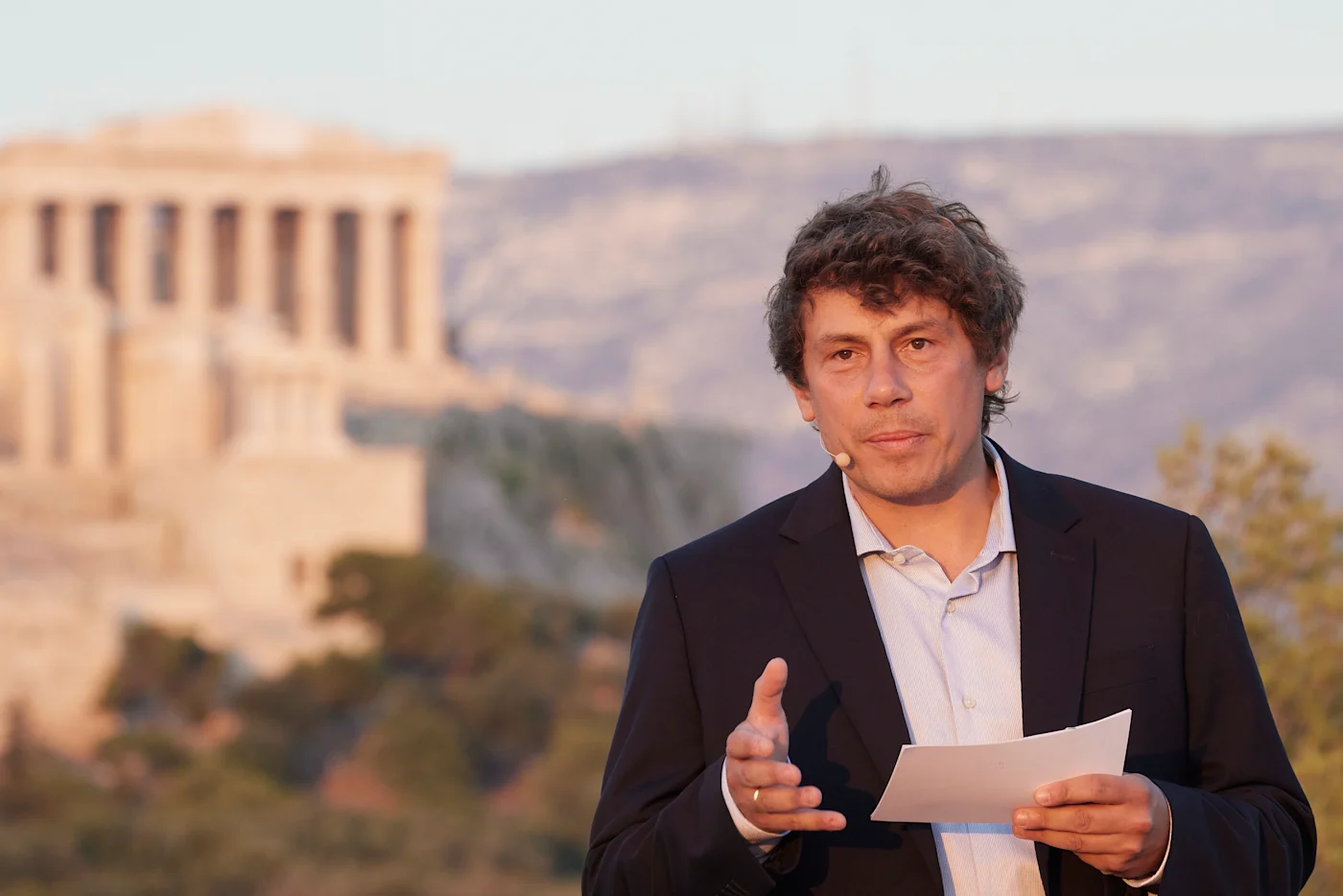
It was the right room. Opening the third Athens Innovation Summit, Costantza Sbokou-Constantakopoulou - Co-Owner & Chairwoman of Phāea, Chairwoman of Endeavor Greece since 2017 and UNESCO Goodwill Ambassador for the Protection and Promotion of Culture - began with the ground beneath everyone's feet. The word Pnyx, she explained, comes from the ancient Greek pyknos: density, compression, the concentrated force of many minds in one place. This is where thousands of citizens once stood shoulder to shoulder to decide the business of the city. But pyknos meant more than a density of bodies; it was a density of purpose - individual voices compressed into a single collective will. "The assembly did not merely gather people," she said. "It concentrated power." Endeavor, she added, was built on the same instinct: collective mind power, composing one global ecosystem.

Then Panagiotis Karampinis, Regional Managing Director for Europe and Managing Director at Endeavor Greece, on why everyone had climbed the hill. Endeavor Greece launched this summit in 2022 with one simple idea: put the world's leading minds in technology face to face with the people shaping our policy, and place both in front of the questions that matter most. "Tonight we stand before entrepreneurs from Elsewhere," he said - founders from Kyiv, in the middle of a war, from Warsaw, Colombia, Venezuela, Greece, Jordan. Not just Silicon Valley. Because Elsewhere, it turns out, is where many of the world's most important companies are built - not despite instability, but often because of it. "This night is for every entrepreneur, somewhere the world hasn't noticed yet, building something that will outlast us all."
The line Endeavor was built on
That belief is exactly why Endeavor exists. "Talent is everywhere," said Linda Rottenberg, our co-founder and CEO. "It's opportunity and capital that aren't." She has been saying it since 1997, when she started Endeavor and, by her own account, most people thought she was crazy for suggesting there were great founders outside the Bay Area - chica loca. Her rule from those years still holds: "No is a starting point. No is never the final answer."
Rafał has spent a decade proving the first half of that sentence. He kept ICEYE in Europe when plenty of advisers told him it would fare better re-registered in Delaware. He hired the world: across roughly 1,000 people, the company spans 75 nationalities, and its largest single nation is only 16% of the team. That was deliberate. "If talent is everywhere and everyone else is in the Bay Area," he said, "then we get access to it more easily." Underneath it all is a discipline he keeps returning to: "Everything can be broken down into fundamental first principles. As long as the first principles are true, your mission should stay true."
Now, a factory in Greece
Greece is now part of that map. ICEYE arrived two years ago with a single employee brought home from London; the office is now close to 30. And the company has committed to a factory that will build up to 150 satellites a year - "three satellites every week," as Rafał put it - a plant the Prime Minister said could employ more than 250 highly skilled people. Why here? "An enormous amount of talent potential," he said, pointing to Aristotle University interns who turned out to be exceptional, "a phenomenally well English-speaking society," and a government willing to work hand-in-hand with a startup.
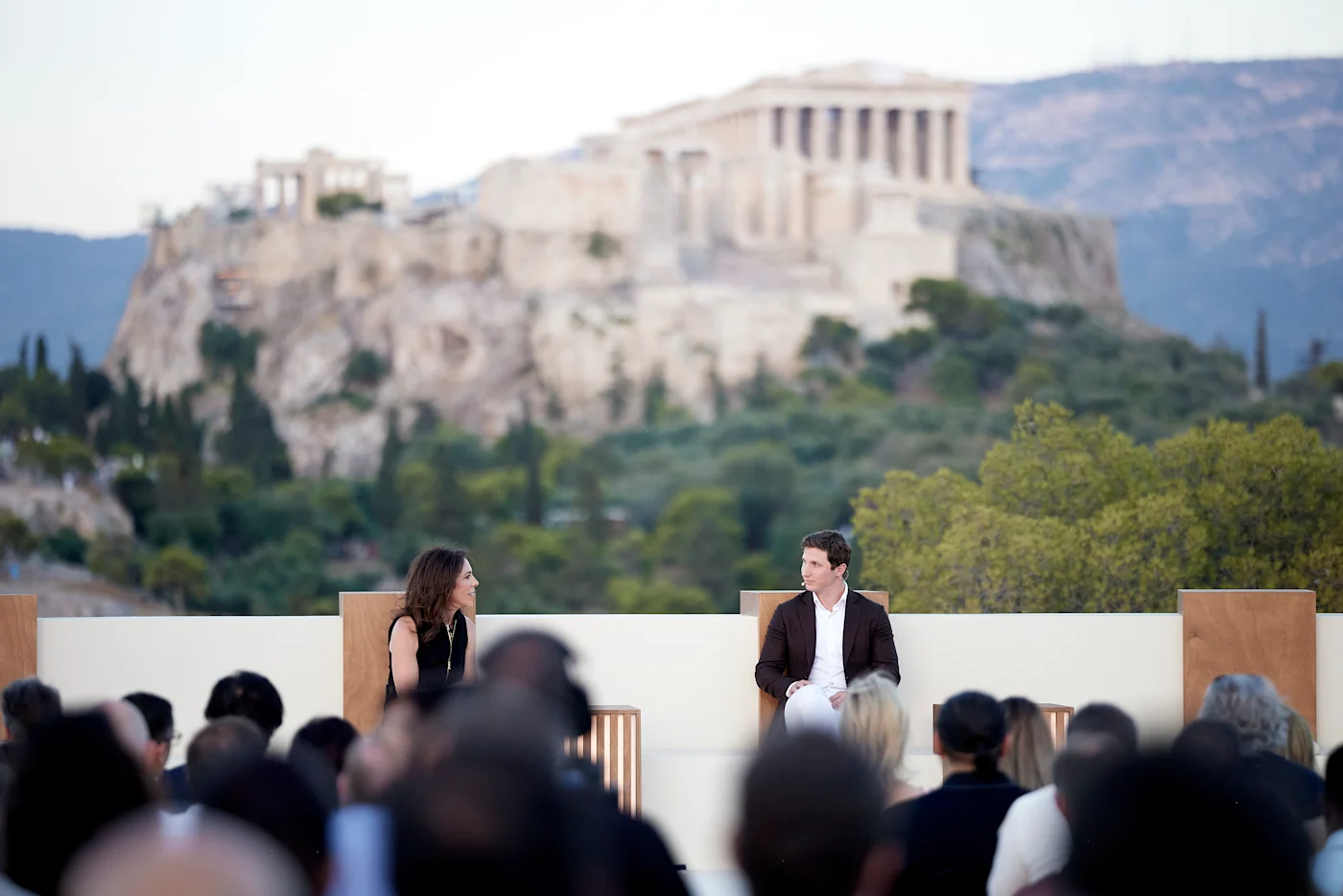
The Endeavor part of the story ran late into Thanksgiving Eve, and Linda told it in full. ICEYE's round was one of the most competitive our capital team had ever seen; the board had set a minimum far above Endeavor Catalyst's usual ceiling. The answer, at first, was a polite no. Then, hours before the holiday dinner, a spot opened - €5 million, its largest-ever check, decision by tonight. Within the hour, the investment committee said yes. Six months later, the company was valued roughly four times higher: just six months after closing a Series E at a €2.4 billion valuation, ICEYE returned with a Series F that valued the company at over €10 billion.
"Businesses aren't about technology, they aren't about markets," Rafał said. "They're about people. As long as you have the right people on your side, you're going to be successful." Today ICEYE is itself a limited partner in Endeavor Catalyst - the Multiplier Effect™ in a single move: founders backing the next generation of founders.
"Greece is open for business" - with eyes open
Prime Minister Kyriakos Mitsotakis made the case for Greece as a place to build, not just to buy: pilots that put AI beside nurses, a partnership with OpenAI to help teachers plan lessons, and a collaboration with ElevenLabs spanning public services and Gov.gr, tourism, and the preservation of endangered Greek dialects. He described a defence budget deliberately opened to startups for proof-of-concept work, and a diaspora eager to come home to great universities and a quality of life that's hard to argue with. "Greece is open for business," he said.
He was also candid about the stakes. The more capable these models become, he warned, the fewer people actually understand them - and "the tail risk of something going wrong is too big to ignore." On AI at work, his line was that it should augment, not replace: "As long as this does not mean replacing the nurse, it's a positive-sum project." He was most passionate about children, defending Greece's move to keep under-15s off the big platforms and pushing for an EU-wide framework. And he turned philosophical about the rest, describing a test-run of an AI "digital twin" trained on his own speeches: "It was a mirror image of me, able to speak like myself - but it was not me." Beneath it sat a political argument too - that a moderate, centrist government can believe in free markets and still hold that "profound inequality is catastrophic for social cohesion," and that "you can defeat the populists by delivering on your promises."

"Do we really want seven companies to rule the world?"
Hemant Taneja, CEO of General Catalyst and an investor in both ICEYE and Anthropic, framed the evening with a single question: "Do we really want seven companies to rule the world? That's not good for the rest of the world - and it's not good for America." He pointed to the sheer pace of it - Anthropic's run-rate revenue has climbed from roughly $9 billion at the end of 2025 to $47 billion by mid-May 2026, and Nvidia added a trillion dollars of market value in just over 100 days on its way to becoming the first $5 trillion company. "That's bigger than most economies in the world."
His answer is what he calls counter-concentration: "global resilience," and "strategic autonomy" for every region - platform companies built outside the Valley, from ICEYE to Mistral to Helsing. And he argued that at the application layer, founders from elsewhere hold an edge, not a handicap: "The entrepreneur who will solve a problem in Greece actually lives here, because they have the empathy for what needs to be done here." Abundance delivered by a handful of firms, he added, isn't really abundance: "Abundance without agency is not abundance."
Asked to sum up the next ten years in a word, he chose two: "Worried. And love." The lightest moment of the night came right after: offered a technology he loves that has nothing to do with AI, the Prime Minister chose fusion. Taneja's reply drew the biggest laugh of the evening - "Fusion will solve AI."
What you can see from orbit
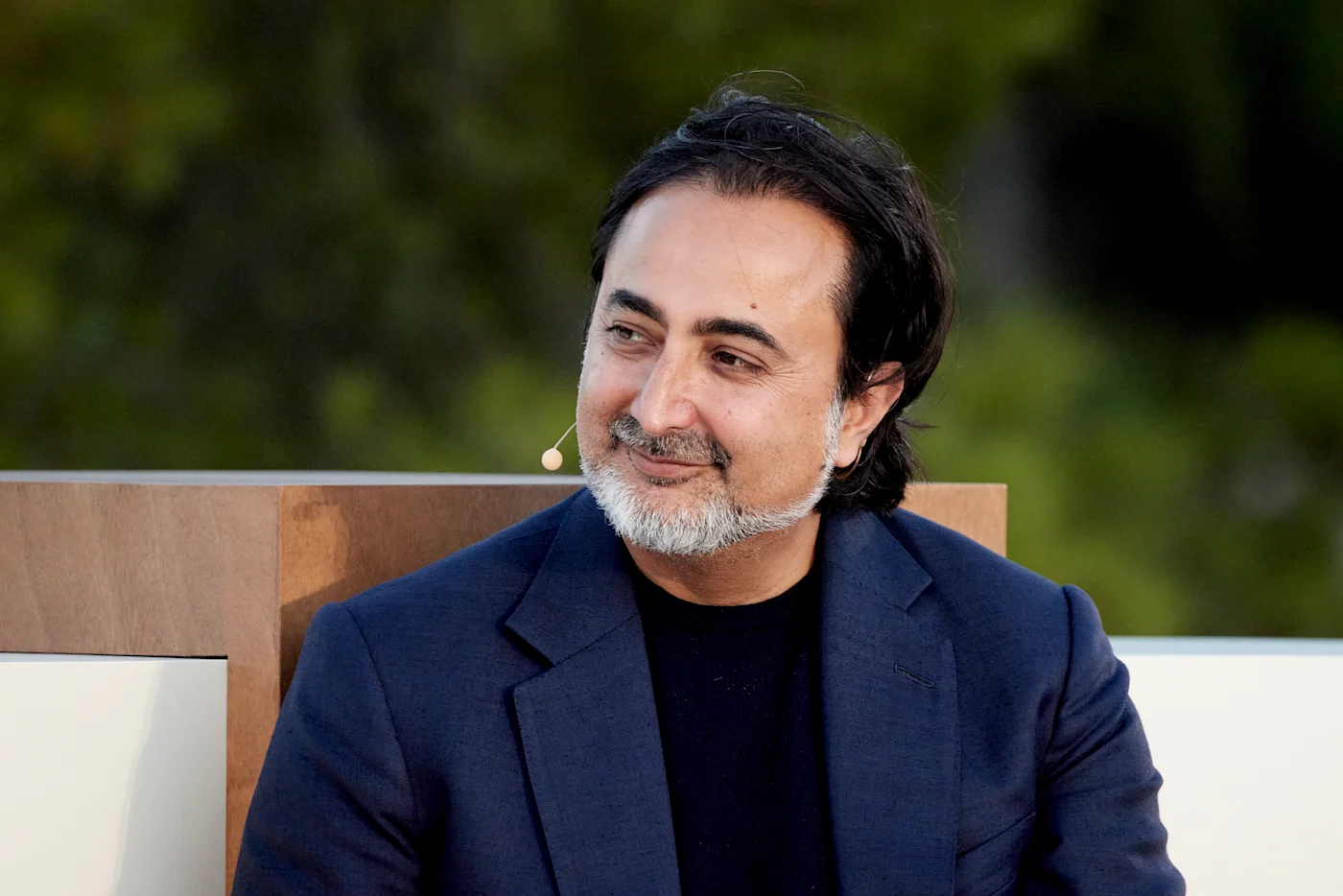
We gave Rafał the last word, and asked what he can see from space that the rest of us can't. The world, he said, has become far more dynamic - the sheer variation in where people now want imagery taken has "massively increased." And the revolution, in both AI and space, is still in its infancy. "There's just so much more to come."
On a hill built for deciding the future, that landed less like a forecast than an invitation. Talent is everywhere. So, this week was the proof.