PODCAST
Outliers Podcast S7E1 | Panos Stavropodis, Elyos AI
By Endeavor Greece
Jul 09, 2026
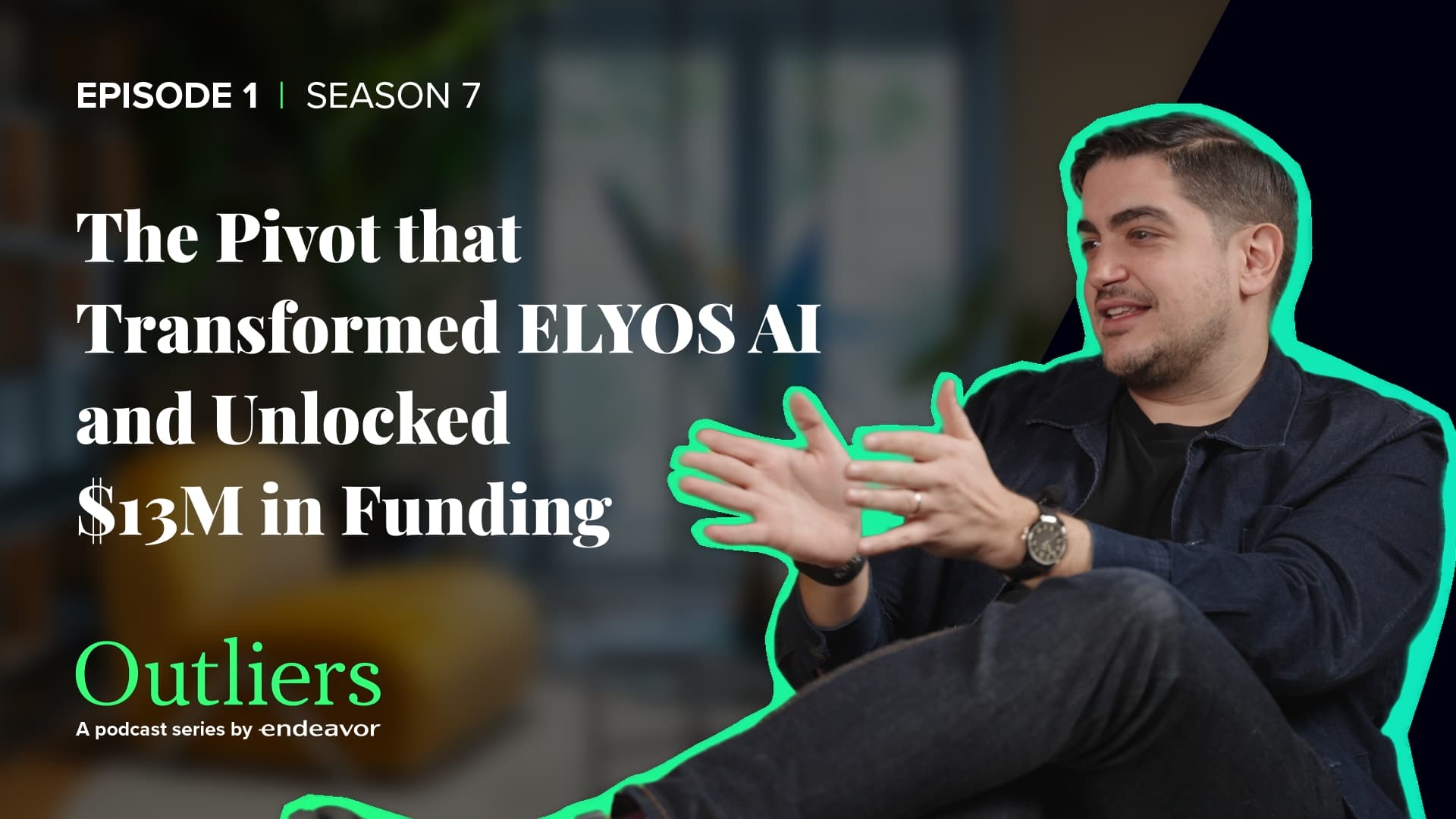
Panos Stravopodis on curiosity, a three-month corporate career, the pivot that saved Elyos AI, and why resilience beats brilliance
The Outliers Podcast - Season Premiere
Before Y Combinator, before London, before a company handling forty thousand calls a week, there was a teenager on Zakynthos taking apart motherboards for fun.
Panos Stravopodis grew up on the island with a father obsessed with computers - a Windows 95 machine in the house when that was the cutting edge. By fifteen or sixteen he was writing Visual Basic and had already decided this was the world he wanted. What he couldn't have known was how long and winding the road from that bedroom to a venture-backed AI company would be.
Today Panos is Founder and CTO of Elyos AI, which builds AI agents for the trades and field services industry - plumbers, electricians, heat-pump installers, the companies with 40–50 engineers and a 10-15 person call center drowning in phone calls. The agents work the phones, email, and WhatsApp around the clock, plug straight into the customer's CRM, and book, diagnose, and dispatch jobs on their own. To open the new season of The Outliers Podcast, Panos walked us through the whole journey.
The trait that started everything: curiosity
His first real product came during university at Patras, over a summer back home. A hotel owner he knew from his radio days - Panos worked professionally as a DJ for six years while studying - mentioned that his boutique hotel group had no online booking system, and that everything on the market was built for Germany or the Netherlands, not Greece.
"I had some time that summer, so I said - do you want to build something and see how it goes?"
That "something" ran for three years with almost no maintenance and handled around 3,000 bookings. More than the numbers, it taught him what he'd later call the founder's core trait:
"One of the most important traits of a founder is curiosity."
Seeing that he could integrate with banks, payments, real systems - and that a customer used what he built immediately - lit the fuse. Around 2010–2011, in the depths of Greece's crisis and with no startup ecosystem to speak of, he stumbled onto Y Combinator through, of all things, the Dropbox website. YC felt like a distant dream. Thirteen years later he'd be inside it.
A three-month corporate career
Panos's résumé reads like a deliberate education in how startups actually work. After a master's in Amsterdam - where a mandatory startup internship taught him more in four months than years of coursework - he took a "safe" job at a corporate data center. It lasted exactly three months.
"My corporate career lasted three months. What I was missing was the previous thing - moving fast, having a real impact with your work. For me that matters enormously."
So he went startup-hopping, on purpose. At Bynder in Amsterdam he joined a year before the Series A and watched the team grow from ~50 to 350 in two and a half years, learning the real challenges from the inside. In London, Funding Circle gave him fintech at scale - roughly a thousand people, consolidating platforms across Germany and San Francisco ahead of an IPO. Then, in 2020, Bulb - a green-energy company whose mission pulled him in.
At Bulb he built three things that would matter enormously later: the UK's first smart-energy tariff offering, an in-house billing platform, and - crucially - the call-center software from scratch. He also lived through the company's collapse, working 14–15 hour days through a government-managed restructuring while running a 170-person team. That was the turning point.
"I was spending most of my day on managerial problems - meetings, Slack, why this, why that. It wasn't what I enjoyed."
He wanted more impact and more control over what got built. He wanted to be a founder.
Five weeks to blow up your life
The co-founders found each other almost by accident. Panos had met Adrian back in 2020 through YC's Startup School; Adrian brought in Pip, whom he knew from his MBA. All three had energy and climate backgrounds - Panos at Bulb, Pip at OVO, Adrian in BCG's energy practice - so the direction felt obvious.
They applied to YC almost as an afterthought, heard nothing for two months, and assumed it was dead. Then, in May 2023, the email came: interview now, program starts in June.
The interview itself was a stress test. As Panos describes it, the partners deliberately start from disbelief.
"They start out not believing you. And you have to convince them why it's a good idea."
It worked. They were accepted in May; the program began June 14th. In five weeks Panos had to hire his own replacement as VP of Engineering, wind down his life in London, and move to San Francisco - where YC pushes founders not just to work together but to live together.
"You're suddenly 24/7 with the same people - who you don't really know that well."
The bet paid off. During YC they closed their pre-seed and seed rounds and returned to London that October. There was even a "wow moment" that made the whole gamble feel real: an invitation to Paul Graham's house, where he understood their business in five minutes and handed them five pieces of advice that were, in Panos's words, 100% accurate - knowing almost nothing about them.
The pivot that saved the company
Here's the part I got wrong in the first draft - and the real story is far better.
Elyos didn't start in field services at all. The original YC idea was AI agents for energy optimization in commercial and industrial buildings: connect to a building's systems, understand its consumption, cut waste, even sell energy back to the grid. Interesting problem. Brutally complex.
"The complexity of connecting to buildings and controlling every device made everything slow."
A year in, around September 2024, the numbers told the truth. Revenue was stuck at roughly €200k while cohort-mates were hitting millions - and, as Panos puts it, one of the sharpest gifts of a program like YC is that you're constantly measured against the best. They sent Pip to sell in New York for a month, tried a sustainability angle, and saw no real change. In November 2024, they decided to change course.
The pivot came from looking backward at what they already had. In the energy business they'd worked closely with installers - the people fitting the batteries and solar panels - a market that turned out to be badly under-served by software. And Panos had already built call-center automation at Bulb, while Pip had managed exactly these kinds of installer networks. At the same time, voice AI had just crossed a threshold: real-time APIs after summer 2024 meant agents no longer sounded robotic.
They started with two installers they already knew, built an MVP in December, landed their first non-pilot customers in January, and shipped a full end-to-end product in February - nights of 18–19 hours to build the product and the CRM integration in parallel.
"What took us over a year on the old product, we did in the first or second month of the new one. That's when you know something works."
Then came ~30% monthly growth and a Series A that December.
What the product actually does
The simplest way to picture it: your boiler breaks, you call your plumbing company, and an Elyos agent picks up.
"One of our agents answers the line and helps you - and the agent - understand exactly what the problem is."
Many agents carry real technical know-how: if a boiler throws a specific fault, the agent might suggest checking the pressure or topping up the water, the things people already try. If it's not resolved, it triages - urgent-now versus someone-tomorrow, with categories that adapt per country. From there it takes your details, runs an on-call process in the background (calling engineers one by one, escalating to a manager if no one answers), or books and schedules the job straight into the CRM via a scheduling engine Elyos built in-house. Some customers even take payment through the agent.
And the whole thing is measured. Elyos runs roughly 30–40,000 calls a week, including outbound reminders - but volume isn't the point.
"What matters is putting a value next to each call. On average our customers get about £5,000–6,000 out of this alone - and that's before the 24/7 coverage and everything else, which they pay for separately. It makes the value of the product easy for customers to understand."
The moment it stopped being about numbers
Ask Panos when he knew the work mattered on a human level, and he didn't reach for a revenue chart. He describes a customer with about 100 engineers running a punishing 60% "no-access" rate - technicians showing up to jobs where nobody was there to let them in. For compliance work like gas safety checks, that's a disaster on both sides, and it was costing the company £20,000–30,000 a week.
Elyos took that no-access rate from 60% down to 12%, cutting the weekly loss to a few thousand. That's the number he's proud of.
Why he isn't afraid of the technology
You'd expect a CTO in the most crowded corner of AI to worry about barriers to entry collapsing. Panos flips it around.
"The barrier to building an agent keeps getting lower - the infrastructure isn't the hard part anymore. How well those agents actually work is what makes all the difference."
The moat, he argues, is in the workflows and the deep understanding of the industry: knowing exactly how customers think and which problems are worth solving. That's execution, not technology - and it's why he believes the winning companies are simply the ones that adapt fastest to whatever comes next.
Looking to 2036, he pictures a world of human supervisors each managing teams of five, ten, or twenty AI agents doing different jobs - with human communication still very much in the loop. And pressed on what actually makes an outlier founder, he keeps it grounded:
"For me it's resilience and consistency. Most people quit at the first real difficulty. A startup is a total roller coaster - but the reward of building something, and building a great team, is bigger than you can describe any other way."
🎧 Listen to the full episode of The Outliers Podcast - season premiere, out now.
Companies Mentioned :

Elyos AI