PODCAST
Outliers Podcast S7E2 | Stefanos Loukakos, Connectly.ai
By Endeavor Greece
Jul 09, 2026
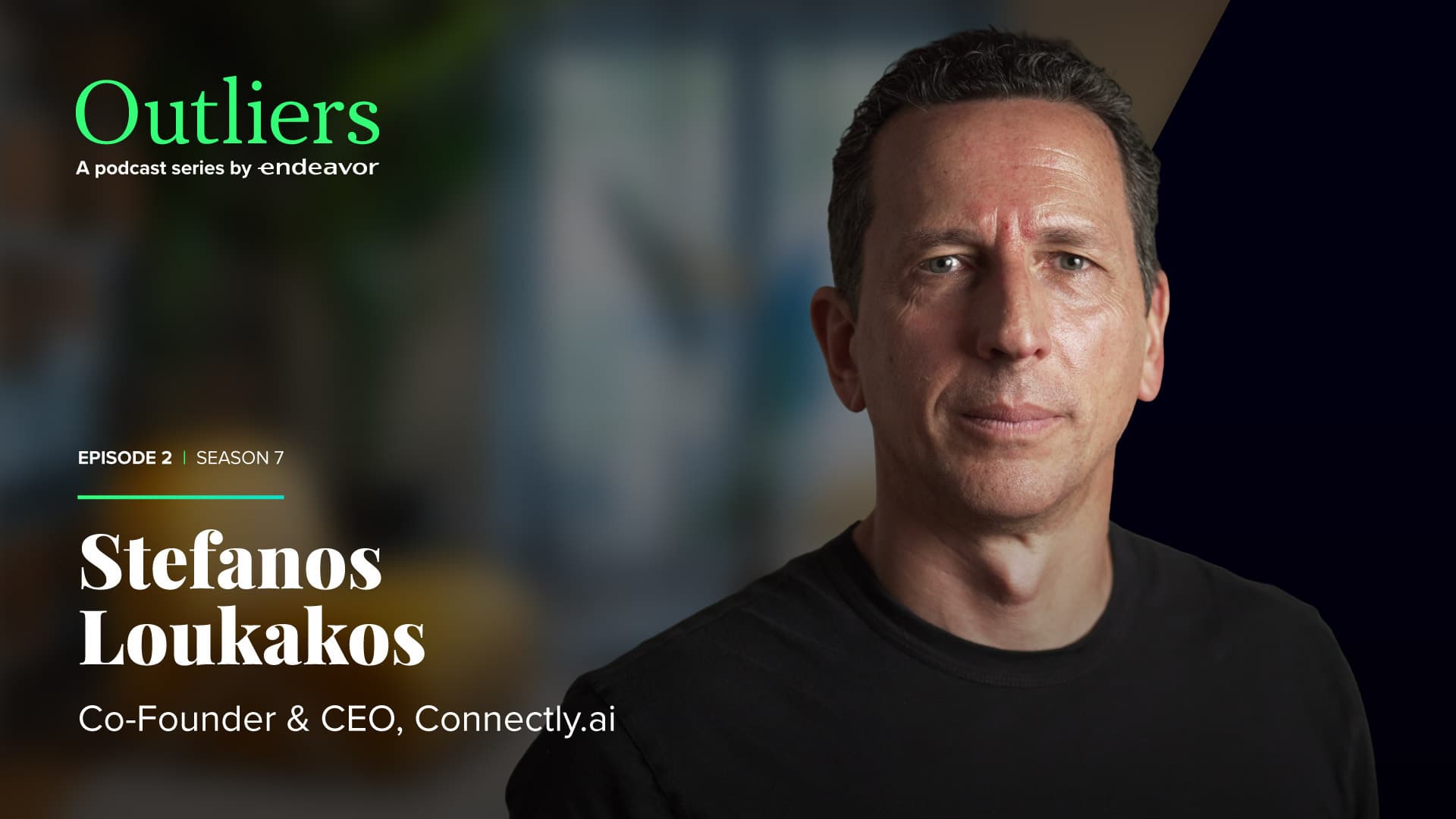
"Eighty Percent of Success Is Showing Up"
Stefanos Loukakos on running Google Greece, betting on messaging before AI made it obvious, and why building a company is "diet hard," not "physics hard"
The Outliers Podcast - New Season
A venture capitalist offered Stefanos Loukakos, Stefanos Loukakos - Co-Founder & CEO of Connectly.ai, three and a half million dollars on a single phone call. He didn't have a co-founder. He didn't have a product. He didn't even have a company name yet.
He'd called his friend John Briones - head of Unusual Ventures - just to sanity-check an idea and ask who he should talk to. Briones' answer was to invest. By that afternoon, a term sheet was in Stefanos' inbox. He now had to go find a co-founder and, within two days, a name. That name became Connectly.
It's a story that sounds like luck. Stefanos would tell you it's something more repeatable than that.
The principle underneath the whole career
If there's a single thread running through his path - civil engineering at Athens' National Technical University, a master's at Berkeley, another at Stanford, an MBA at INSEAD, then Google Greece, then Facebook - it's a line he borrows from Woody Allen.
"Eighty percent of success is showing up. Literally. Make the call. Knock on the door. So many people think 'I'll do it' - and never do."
He points to his own Facebook years to prove it. When a bigger role opened up in California, he didn't wait to be the obvious candidate. He called the hiring manager on a Monday, flew to the U.S. the next day to interview, and got the job - moving his family across the world instead of to the London role he'd already lined up.
"The people who win aren't always the smartest or the most capable. Sometimes they are - but not always. They're the ones who try, and actually do it."
What Connectly actually builds
Connectly puts AI agents on the messaging channels people already use - WhatsApp, Messenger, Instagram, SMS - and lets businesses do real work through them: sales, customer support, recommendations. The company grew up in Latin America (largely Brazil, almost by accident) and the U.S., and is now looking hard at Europe.
Stefanos is blunt about the design principle that separates a useful agent from a novelty:
"Nobody wakes up in the morning wanting to chat with customer support. You want to return a broken product, buy something else, get a recommendation that actually fits you - short, and to the point."
So Connectly doesn't build bots that talk. It builds agents that get things done. And that, he says, is much harder than it looks.
"Everyone sees the LLMs on top - OpenAI, Claude, Gemini. But underneath there's testing, optimization, orchestration. Five thousand things companies find very hard to do themselves."
The real work is the unglamorous plumbing: deep integrations into a company's billing system and CRM so the agent knows who it's talking to and what they've bought, plus the guardrails that keep it driving toward a goal instead of hallucinating its way through a conversation. His bet is that almost every company will want its own agents within a few years, and that 99% of them won't be able to build the underlying platform alone.
The pivot most companies fear
Connectly didn't start here. Before the current wave of AI, it was a platform for building deterministic flows - buttons and menus inside a chat window. Then ChatGPT arrived, and Stefanos saw the ground shift.
"We saw there was an enormous space to automate how companies communicate with customers. So we made a big pivot."
He's candid that the change was hard, and not because of the technology. It's that nobody - not teams, not customers - actually wants to change.
"We understood that's where the future was. But there's fierce resistance to it. In everything, there's resistance."
Making the turn meant reshaping the team: more AI-savvy engineers, and a different kind of salesperson. Where the old product was closer to plug-and-play, agents require consultative selling, so Connectly began hiring ex-consultants from firms like McKinsey and BCG who could sit with a customer and build the project alongside them.
"Diet hard, not physics hard"
Ask Stefanos how you actually win at this, and he hands the mic to his first investor again, with the quote he calls his favorite:
"Succeeding at a startup isn't physics hard - it's diet hard."
Meaning: it isn't about solving one brutally difficult equation. It's about consistency - showing up every single day and chipping away, the way a diet works. There's no single move that makes you a billionaire overnight. You keep solving real problems, and the results compound.
That belief shapes how he reads the whole AI moment. The winners, he argues, won't be the companies doing flashy demos - they'll be the ones solving genuine business problems. And he's convinced the biggest player of this era hasn't fully arrived yet: just as Altavista and Lycos gave way to Google after 2000, he expects a company bigger than today's giants to emerge in the years ahead.
A word on Greece
Having run Google in Athens and mentored founders through Endeavor, Stefanos is warm but clear-eyed about the Greek ecosystem. The problem isn't talent.
"It's not that Greece doesn't have good engineers. It's that it doesn't yet have enough big successes for people to look back on. Being a good engineer is one thing. Having seen how great products are actually built is another."
That, he says, is what a Silicon Valley résumé quietly gives you - you've watched world-class companies run up close, and you carry those processes into whatever you build next. His hope is that Greece builds enough large, excellent companies that the next generation can learn it at home, and that the ecosystem becomes a magnet for international talent, not just returning diaspora.
So what makes an outlier?
Fittingly for a podcast named after the Malcolm Gladwell book he loves - the one arguing that success is part effort, part luck, part being in the right place at the right time - Stefanos resists the label for himself. But pressed for a definition, he keeps it short:
"Goals, ambition, and always moving forward."
🎧 Listen to the full episode of The Outliers Podcast - new season, out now.
People Involved :
Companies Mentioned :