TALK
Leadership Beyond the Founder
By Endeavor Greece
Feb 17, 2026
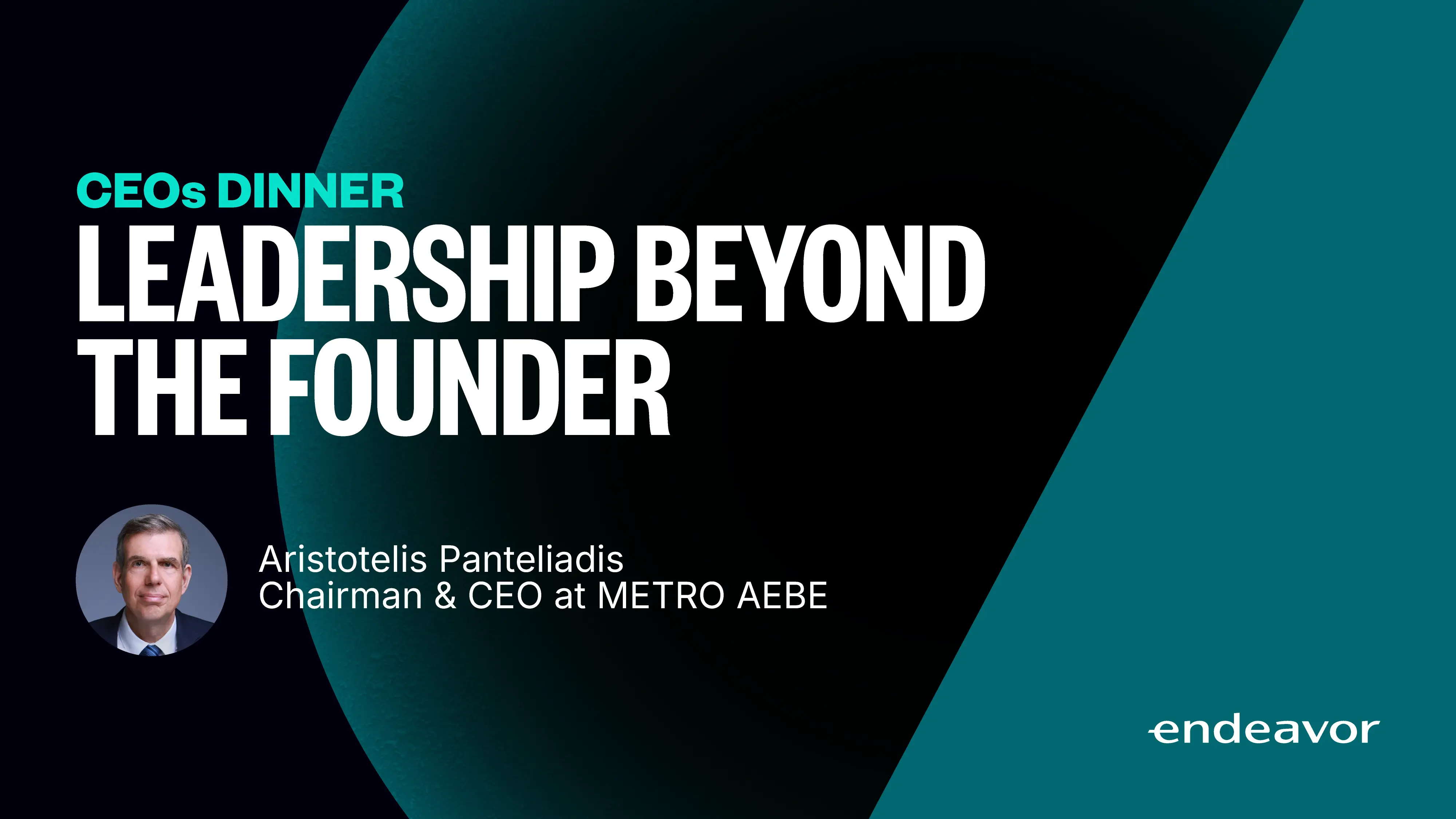
On a recent evening at the offices of Endeavor Greece, a small circle of founders and ecosystem leaders came together for a closed-door CEOs Dinner, shaped by open conversation and shared experience.
At the center of the discussion was Aristotelis Panteliadis, Chairman & CEO at METRO AEBE, representing the second generation of leadership in one of Greece’s most significant family-built business groups. Over five decades, the group has grown from a small entrepreneurial beginning into a nationwide network spanning retail, distribution, and food production, with a cautious but deliberate step beyond Greece’s borders.
Yet the conversation that unfolded was not about scale or performance.
It turned instead to quieter questions: how trust holds across generations, how structure emerges as companies grow, and how founders learn to build organizations that must eventually live without them.
In an era shaped by speed, capital, and constant disruption, a more difficult question lingered beneath the discussion:
What does it really mean to carry a company forward?
Entrepreneurship Before Scale
Every enduring organization begins in uncertainty. Long before governance, hierarchy, or market share, there are only a few people and a fragile belief that something might work.
Fifty years ago, the companies that now form a major Greek business group were exactly that: small, improvised, human. Their evolution reflects a broader truth often overlooked in modern startup culture.
Growth does not eliminate uncertainty. It transforms it.
Early on, the risk is survival. Later, the risk becomes coherence-across people, strategy, and time.
And coherence cannot rely on instinct forever. At scale, structure becomes responsibility.
Trust as Infrastructure
Family businesses are often described through ownership. In practice, they are governed by relationships.
The most revealing moments are not periods of expansion, but periods of stress. When performance weakens or decisions divide generations, trust either deepens - or breaks.
Many corporate failures attributed to markets are, in reality, failures of alignment.
Yet when trust holds, family ownership creates rare advantages:
Commitment measured in decades, not quarters
Emotional identification with outcomes
Strategic patience unavailable to purely financial actors
This is not sentimentality. It is a different model of durability.
The Entrepreneurs' Psychological Transition
Scaling a company is commonly framed as an operational challenge. More accurately, it is a personal one.
Moving from a handful of employees to hundreds requires entrepreneurs to release something fundamental: control.
They must allow:
Decisions they would not take themselves
Errors they would have prevented
Rhythms they cannot fully oversee
Without this surrender, organizations stall at the size of the entrepreneurs’ capacity. With it, they gain the possibility of independent thought.
But the transition carries quiet costs. People who were essential early on may no longer fit later stages. Loyalty alone cannot determine leadership in complex systems.
These decisions rarely appear in entrepreneurial mythology-yet they define whether companies endure.
Succession Without Illusion
Few topics are handled with less honesty than succession in family enterprises.
One principle stood out with unusual clarity: the next generation must remain free not to join.
Passion is not inherited. Competence is not genetic.
Forcing continuity often destroys both family harmony and business performance.
A more resilient approach includes:
Professional experience outside the family company
Objective criteria for leadership roles
Formal governance frameworks-often codified in a family constitution
Such systems transform succession from an emotional event into an institutional process.
And institutions, unlike intentions, can survive time.
When Scale Slows Organizations Down
As companies grow, fragmentation follows.
Communication weakens. Strategy diffuses. Only a minority of employees remain connected to long-term direction.
This is the hidden bureaucracy of success.
Paradoxically, crises reverse it. During periods such as the pandemic, large organizations often rediscover:
Speed of decision-making
Collective purpose
Personal initiative beyond formal roles
The deeper leadership challenge is not crisis response. It is sustaining urgency in normal times.
Very few organizations manage this. Those that do retain the energy of a startup within the structure of scale.
Local Intelligence in a Global Economy
Greece provides a revealing contrast between multinational scale and local resilience.
Several global retailers entered the market with capital and systems, then exited. Domestic, often family-rooted companies remained.
Their advantage was not size, but proximity:
Understanding everyday consumer behavior
Adapting quickly to volatility
Building trust-based supplier relationships
Scale delivers efficiency. Closeness delivers endurance.
For entrepreneurs pursuing international growth, the lesson is subtle but critical: expand reach without losing intimacy.
Innovation and Emotional Discipline
Entrepreneurship rewards imagination, but survival requires detachment.
Ideas that feel visionary may fail. Technologies that appear inevitable may disappear.
The discipline lies in refusing emotional attachment to unproven concepts:
Test quickly. Measure honestly. Abandon without hesitation.
Failure, in this sense, is not the opposite of success. It is its filter.
Data, Platforms, and the New Economics of Retail
Modern retail operates under structural pressure.
E-commerce is often necessary but weakly profitable. Digital platforms provide access to customers while capturing their data. Margins compress as convenience expands.
At the same time, new models emerge:
Data-driven loyalty ecosystems
Retail media as an advertising layer
Franchise formats powered by owner commitment
Together, these shifts signal a deeper transition:
Value is moving from transaction to relationship.
And relationships-again-depend on trust.
The Reality of International Expansion
Crossing borders reveals the true maturity of an organization.
Systems must function without proximity. Teams must operate without cultural familiarity. Patience must extend beyond early losses.
Expansion into Cyprus illustrated this reality-launching at the worst possible moment, just as the pandemic halted core demand. Years later, persistence-not timing-defined success.
Global growth, ultimately, is less about geography and more about organizational depth.
Endurance in an Age of Speed
As the evening closed, no grand statement concluded the discussion. Only a quieter realization remained.
That meaningful entrepreneurship is rarely loud. It is built slowly, relationally, and often invisibly.
Not for valuation headlines. Not for momentary attention. But for continuity.
Outside, Athens moved with familiar urgency. Inside, the conversation had settled on a different rhythm, one measured not in quarters, but in generations.
And in a world increasingly defined by acceleration, endurance may be the most radical strategy an entrepreneur can choose.