TALK
Rebuilding Industry in the Age of Intelligence
By Endeavor Greece
Mar 04, 2026
Rebuilding Industry in the Age of Intelligence
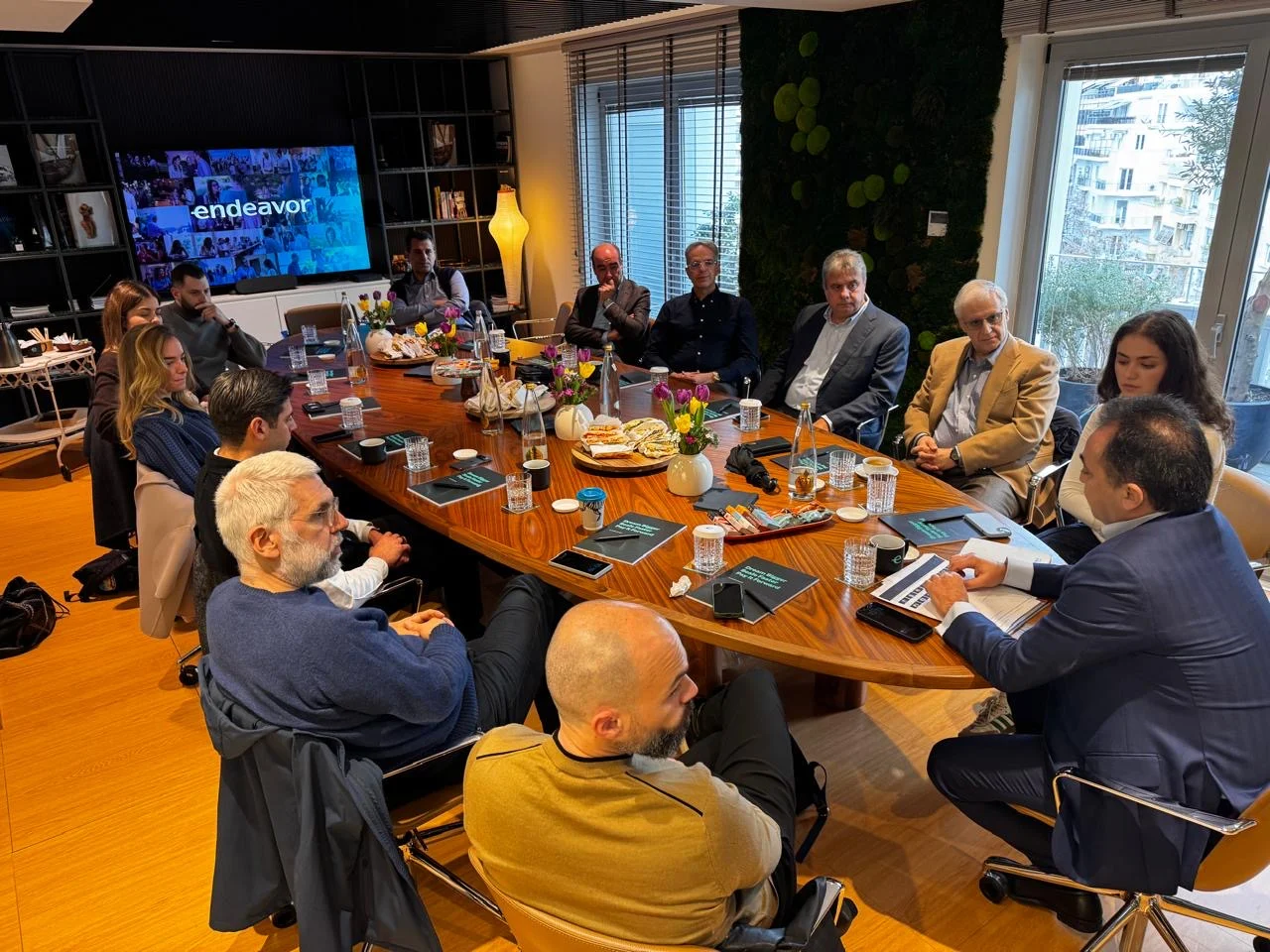
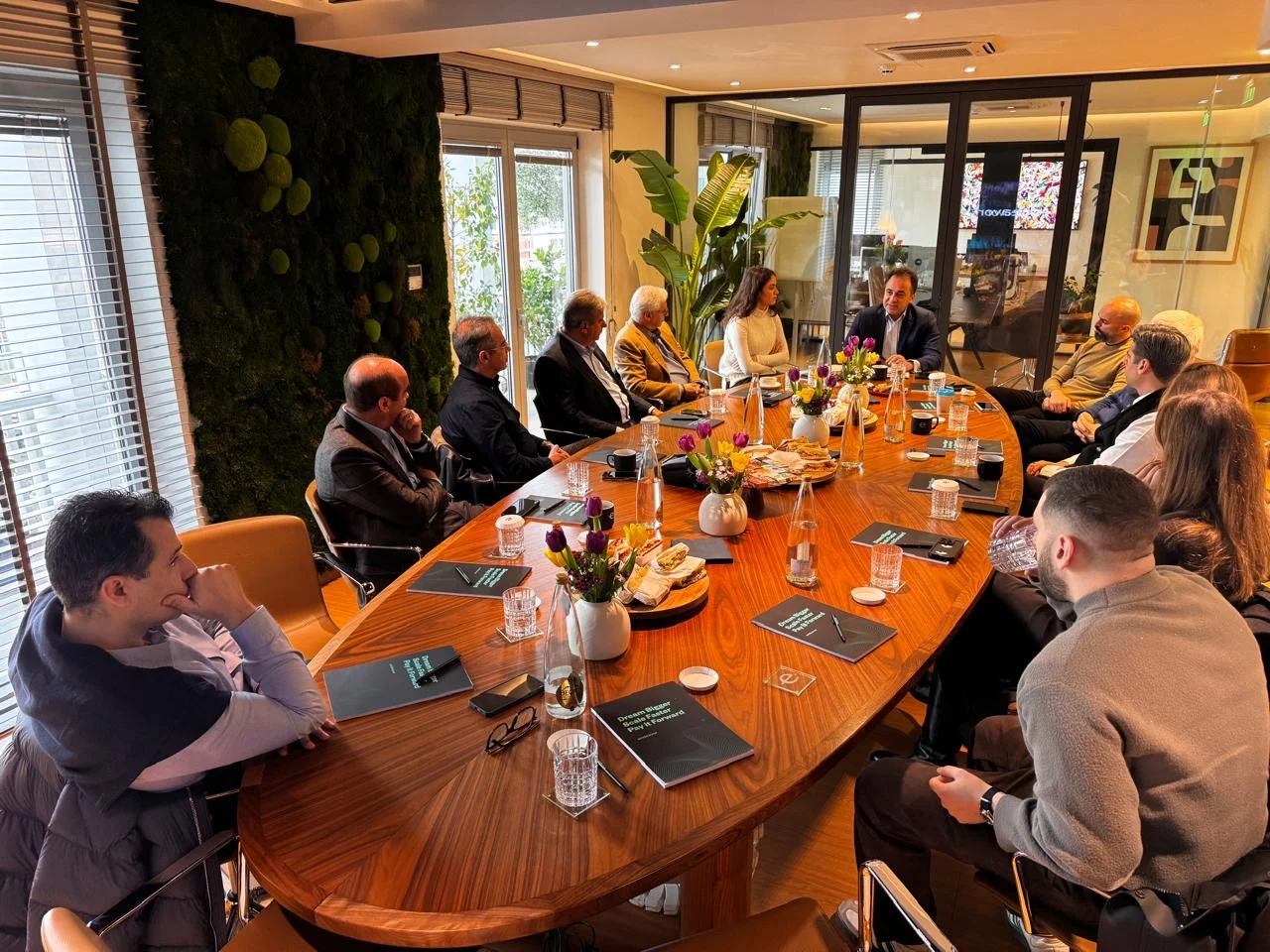
Every era of entrepreneurship eventually arrives at the same moment of reckoning: the realization that what worked before may not be enough for what comes next. On a recent morning at the offices of Endeavor Greece, a small group assembled around a roundtable to confront that realization-through conversation grounded in experience, responsibility, and the long view of building companies meant to last.
At the center of the conversation was Antonis Kyrkos, Chief Digital and Strategy Officer at TITAN Cement Group-a leader working at the intersection of heavy industry, digital transformation, and long-term strategic resilience. Around him sat founders, operators, and ecosystem builders, each carrying a different version of the same question:
What does it take for Greek industry-and Greek entrepreneurship, to remain relevant in a world accelerating beyond familiar limits?
The conversation quickly moved beyond surface observations. Not toward headlines, but toward truths that tend to reveal themselves only in rooms where experience outweighs performance.
And what emerged was not simply a conversation about technology. It was a meditation on competitiveness, safety, culture, and time-the real architecture beneath any company that hopes to endure.
The Structural Reality Facing Greek Industry
Before strategy comes context. And the context, as described in the room, was unambiguous.
Greek industrial companies now compete in a global environment where production costs, energy prices, and labor availability differ dramatically across borders. Facilities in Turkey, Algeria, or Vietnam operate under economic conditions that European manufacturers cannot easily match.
For companies like TITAN-whose production is increasingly export-oriented-the comparison is not theoretical. It is operational, daily, and unforgiving.
Energy alone reshapes the equation. Electricity costs in Greece can be multiple times higher than in the United States or neighboring regions, creating a structural disadvantage that predates recent crises.
Layered on top is a quieter constraint: people.
Across the sector, companies struggle to find both specialized digital talent and workers for essential operational roles. Some have turned to international recruitment simply to sustain continuity-an operational necessity that carries organizational and cultural complexity.
None of this was framed as a complaint. Only as reality.
And reality, in entrepreneurship, is always the starting point for transformation.
Digital Transformation as Industrial Survival
If the constraints are structural, the response must be systemic. This is where the conversation turned toward digital technology and artificial intelligence-not as trends, but as instruments of survival.
Inside modern industrial environments, digital systems can now:
Reduce energy consumption through intelligent scheduling and optimization
Improve supply-chain coordination and production planning
Enable predictive maintenance that prevents costly breakdowns
Enhance worker safety through sensors, vision systems, and automated alerts
In earlier eras, efficiency required new machines. Today, it often begins with data.
And the economics are striking. A software-driven optimization initiative costing thousands can sometimes unlock value comparable to multimillion-euro equipment investments.
But perhaps the most human impact appears in safety.
Safety, Attention, and the Human Factor
Industrial safety is rarely determined by rules alone. It lives in habits, culture, and attention-the fragile space between routine and risk.
The discussion surfaced a difficult truth: experience can sometimes breed complacency.
Veteran workers, confident in familiarity, may take small risks. Small risks accumulate. And accidents often emerge not from ignorance, but from relaxed vigilance.
Here, digital technology becomes less about efficiency and more about care.
Sensors that detect dangerous proximity to machinery. Cameras that identify missing protective equipment. Vehicles that stop automatically when pedestrians approach. AI systems that predict hazardous conditions before they unfold. Drones and specialized robots that monitor environments too dangerous for humans.
Each tool extends awareness. And awareness, in industrial settings, is another form of protection.
Yet even the most advanced system cannot replace culture-only reinforce it.
Why Adoption Remains Uneven
If the benefits are clear, why is adoption still slow across much of the Greek industry?
The answers discussed were practical rather than philosophical.
Measuring Return on Investment
A €20 million machine offers visible output. A €100,000 software system offers probabilistic improvement.
For many small and medium-sized enterprises, this difference complicates decision-making. Digital transformation feels abstract-until it becomes urgent.
Access to Applied Expertise
Companies often encounter vendors selling generic solutions, not tailored outcomes. What they need are partners who understand industrial reality, not just technology.
TITAN’s own journey began with small-scale experimentation, frequently alongside agile startups capable of adapting quickly-an approach that favors learning over certainty.
Continuity Risk
When customized systems depend on a small number of developers, continuity becomes fragile. If knowledge disappears, progress can freeze. Transformation, in this sense, is not only technical-it is organizational.
Cultural Inertia
Perhaps the most complex barrier is cultural. Safety habits, operational routines, and resistance to change rarely shift through instruction alone. They shift through repetition, leadership example, and environmental design.
Technology can guide behavior. But people ultimately decide whether transformation becomes real.
Greece, Europe, and the Innovation Gap
Data points mentioned during the roundtable revealed a broader pattern.
Adoption of artificial intelligence among Greek SMEs remains significantly below European averages. Cloud utilization shows a similar gap.
These are not merely technological statistics. They are indicators of future competitiveness.
Because in the coming decade, productivity differences will increasingly reflect digital maturity, not just labor or capital.
And this reframes the challenge from national to generational:
Will the next wave of Greek companies scale into global relevance-or remain constrained by structural hesitation?
Pathways Forward: Experimentation, Collaboration, Culture
Despite the gravity of the challenges, the tone in the room was not pessimistic. It was pragmatic and quietly optimistic.
Several pathways emerged.
1. Proof Before Scale
Pilot projects and proofs of concept allow companies to test ideas without existential risk. Learning compounds. Confidence follows evidence.
2. Quick Wins That Matter
Predictive maintenance surfaced as an obvious starting point-relatively low cost, immediately measurable, and operationally transformative.
Not every innovation must be revolutionary. Some simply need to work.
3. Ecosystem Collaboration
Rooms like the one at Endeavor exist for a reason. Shared experience reduces uncertainty. Trusted networks accelerate discovery.
Transformation, especially in smaller markets, rarely happens alone.
4. Cultural Leadership
Rules do not create safety. Leaders do.
Through repetition. Through visible behavior. Through environments designed to make the right action the easy one.
Technology supports this shift. But culture sustains it.
Compliance, Complexity, and the European Equation
No conversation about AI in Europe can ignore regulation.
The emerging AI Act, alongside GDPR and broader compliance frameworks, introduces new layers of responsibility-particularly around generative AI and data governance.
For industrial AI focused on optimization, regulation has historically been lighter. That era is ending.
European companies now navigate a paradox:
Higher regulatory complexity
Higher ethical expectations
Potentially slower deployment
Yet also:
Greater trust
Safer adoption
Long-term legitimacy
In the long arc of innovation, legitimacy often outlasts speed.
Beyond Technology: The Deeper Question of Endurance
As the evening drew toward stillness, the conversation widened.
Digital transformation, energy costs, labor shortages, compliance-all are real. All are urgent.
But beneath them lies a quieter question:
What allows a company to endure long enough to matter?
Endurance is rarely technological alone. It is strategic patience. Cultural discipline. Clarity about what must change and what must remain.
In this sense, the future of Greek industry is inseparable from the future of Greek entrepreneurship itself.
Because scaling globally has never been only about markets. It is about mindset.
A Room, A Country, A Direction of Travel
Nothing announced the importance of the evening. No stage lights. No headlines.
Just a table. A conversation. And the slow recognition that transformation is already underway-uneven, imperfect, but real.
This is often how ecosystems evolve. Not through noise, but through rooms where thinking deepens.
And perhaps that is the quiet work of communities like Endeavor: to create spaces where experience becomes shared memory, and shared memory becomes future possibility.
Because the next chapter of Greek innovation will not be written only in code or capital. It will be written in factories, decisions, partnerships, and courage - in the daily choice to build with a horizon longer than uncertainty.
And in the end, the question is not whether transformation will come.
It is whether we will recognize, in time, that the future was already being designed in rooms where people chose to think carefully about what truly lasts.
Endurance, after all, is built quietly-long before the world calls it success.
People Involved :
Antonis Kyrkos