TALK
The Intelligence Economy: Greece at an Inflection Point
By Endeavor Greece
Mar 11, 2026
“We are not living through another technology cycle. We are living through a system reset.”

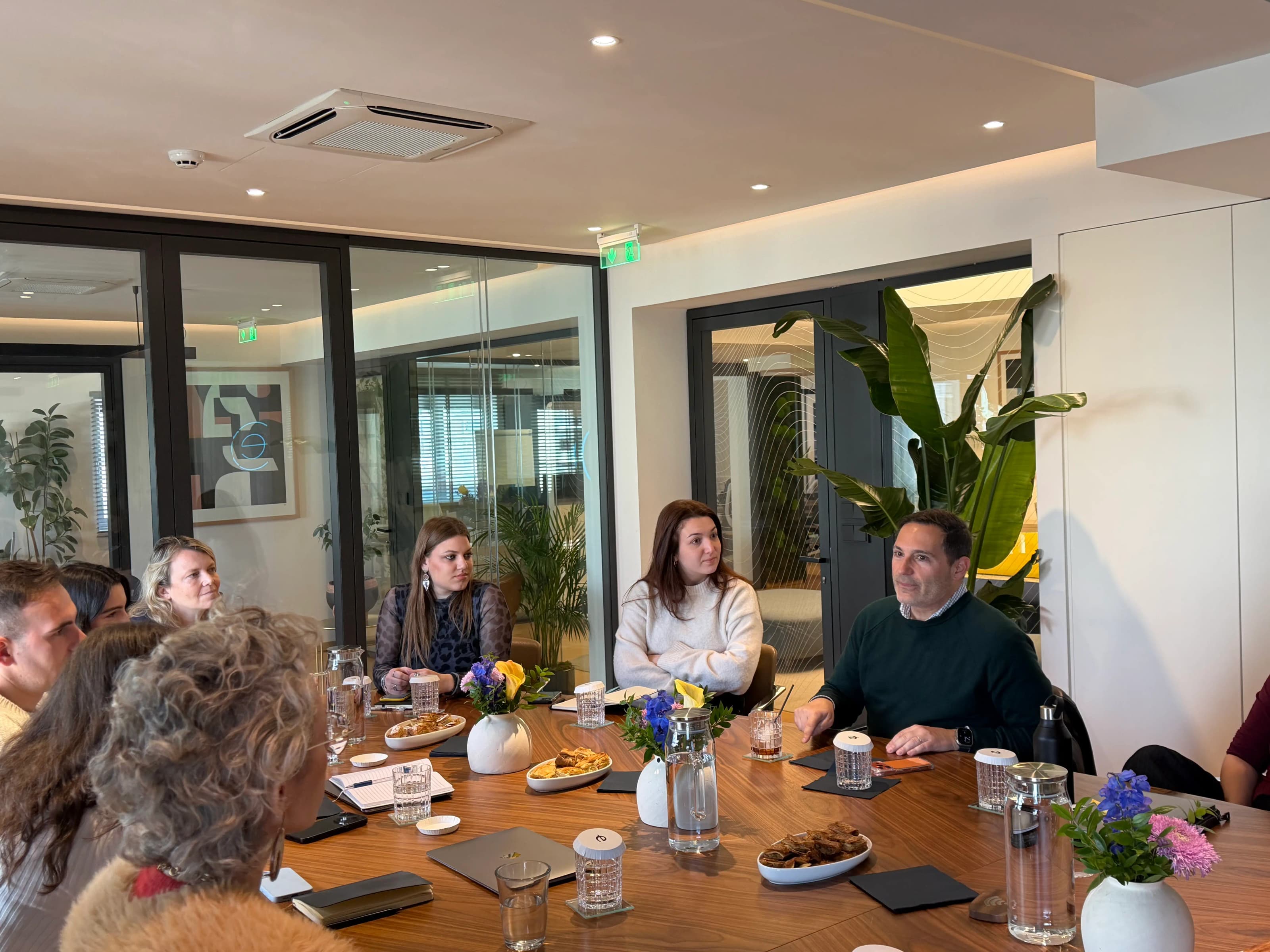
The room at Endeavor Greece was quietly set for conversation. No slides. No product demos. No valuation talk. Just a small group bringing experience from Greece to the United States, from academia to Silicon Valley venture capital, gathered around a single question.
What kind of transition are we actually in?
Artificial Intelligence has been described as a breakthrough, a tool, a risk, a hype wave. But beneath the noise lies something deeper. Not a product shift. Not even a platform shift. A structural one.
For the first time since the industrial era reorganized labor and capital, we are reorganizing intelligence itself.
Drawing on decades of experience in Silicon Valley venture capital, Andreas Stavropoulos - Vice Chairman at Endeavor Greece and Partner at Threshold Ventures - framed AI not as a tool, but as a structural economic transition.
The distinction matters.
And for countries like Greece-rich in research talent, thin in applied scale-the implications are both destabilizing and generative.
This is not about whether AI will matter. It is about how we position ourselves inside a discontinuity.
The End of Linear Progress
For decades, technological progress followed a rhythm we learned to internalize. Moore’s Law was not just an engineering observation; it became a psychological anchor. Every two years, computing power doubled. Systems improved incrementally. Industries digitized step by step.
Industrial economy. Information economy. Platform economy.
Each stage felt additive.
Artificial Intelligence breaks that cadence.
AI is not simply faster computation. It is a compounding capability. It improves as it is used. It reorganizes knowledge production. It reduces marginal cost in domains previously assumed to be human-bound: language, design, decision support, diagnostics.
We are moving from an information economy to an intelligence economy.
In the industrial era, machines amplified muscle. In the digital era, software amplified information. In the intelligence era, systems amplify cognition.
This distinction matters economically.
When cost curves approach zero-as they did with communication through services like Skype-the structure of entire industries collapses and rebuilds. When intelligence generation begins approaching zero marginal cost, the implications are broader still.
The change is nonlinear.
Nonlinear change produces two simultaneous effects:
Rapid growth for those aligned with it
Deep insecurity for those misaligned
That tension-acceleration and anxiety-is what defines our current moment.
And it is why traditional metrics struggle to keep up.
Venture Capital and AI: Investing in Discontinuity
Periods of technological discontinuity distort standard evaluation frameworks. Revenue becomes noisy. Market size calculations become speculative. Incumbent benchmarks lose meaning.
The core principles of investing sharpen rather than soften.
1. Team Over Early Revenue
In stable markets, traction is predictive. In discontinuous markets, adaptability is predictive.
The capacity of a team to learn faster than the environment shifts becomes the primary asset. Early revenue may reflect timing luck more than structural advantage.
In periods of technological rupture, resilience and velocity matter more than early metrics.
2. Technological Inflection vs. Feature Improvement
Not every AI-enabled product represents structural change.
The key question: Is this a feature layered onto an existing model, or does it fundamentally rewire cost, distribution, or behavior?
Feature improvements optimize. Inflection points redefine economics.
Investors during discontinuity look for:
Orders-of-magnitude cost shifts
New distribution channels
Network effects born from usage, not advertising
This is the difference between adding intelligence to a workflow and rebuilding the workflow entirely.
3. Zero-Cost Economics
When Skype drove the cost of long-distance communication toward zero, it did not merely compete with telecom operators. It redefined the expectation of price.
AI has similar zero-marginal-cost potential in areas such as:
Content generation
Customer support
Code prototyping
Data analysis
When marginal cost collapses, incumbents built on high-cost structures become fragile.
The lesson for founders: Do not optimize yesterday’s cost curve. Find the cost curve that is collapsing.
4. Platform Dependency Risk
Technological transitions also produce platform concentration.
History offers cautionary parallels. Companies built on early portals disappeared when search engines consolidated power. Businesses dependent on algorithmic visibility found themselves vulnerable to platform rule changes.
AI presents similar dynamics.
Founders building directly on dominant AI platforms must ask:
What is defensible if APIs change?
Where is proprietary data created?
What becomes uniquely ours over time?
Dependency is not a strategy. Infrastructure is.
In the AI era, defensibility will likely emerge from:
Domain-specific data
Integrated workflows
Human-AI hybrid systems
Trusted distribution channels
Venture capital in the AI era is less about chasing model performance and more about identifying structural positioning.
AI in Greece: The SME Panic Problem
When technological shifts accelerate, large corporations can absorb experimentation costs. SMEs cannot.
In Greece, where small and medium-sized enterprises dominate the economic landscape, AI often triggers a familiar reaction: panic adoption.
A restaurant wants “AI branding.” A hotel wants “AI chatbots.” A retailer wants “AI analytics.”
The impulse is understandable. No one wants to be left behind.
But premature core disruption can destabilize businesses that are already operationally fragile.
The mistake is attempting to rebuild the core before optimizing the perimeter.
Strategic AI for SMEs
AI adoption in SMEs should follow a layered approach:
1. Start with Non-Core Functions
Marketing automation
Customer communication
Inventory forecasting
Accounting simplification
These areas allow experimentation with manageable downside risk.
2. Use AI to Simplify, Not Decorate
AI is not a branding accessory. It is a simplification engine.
If it does not:
Reduce time
Lower cost
Increase clarity
Improve predictability
it is not yet strategically justified.
3. Solve Real Frictions
Instead of improving what already works, SMEs should identify friction points:
Manual reporting processes
Repetitive supplier coordination
Multilingual communication gaps
Seasonal demand unpredictability
AI’s early value in Greece will not come from glamorous product reinvention. It will come from operational clarity.
Digital transformation in Greece cannot mean cosmetic digitalization. It must mean structural efficiency.
AI Infrastructure and the Role of AI Factory
Technological transitions are not navigated by companies alone. They require infrastructure.
An Artificial Intelligence ecosystem is not built solely through startups. It requires:
Research capacity
Compute access
Applied experimentation
Translational bridges
Greece ranks high globally in AI research talent. The challenge has historically been application and commercialization.
This is where infrastructure initiatives like AI Factory matter-not as political symbolism, but as connective tissue.
AI Factory as Enabler
AI Factory’s ambition is not to invent foundational AI models at global scale. That would be unrealistic.
Its purpose is different:
Provide access to high-performance compute (including supercomputing infrastructure such as LOCUS)
Offer technical advisory support
Enable experimentation for SMEs
Bridge academic research with applied industry use
The selected verticals-health, language and culture, sustainability—reflect areas where Greece possesses both talent density and contextual advantage.
Health: Clinical research and data complexity require advanced modeling.
Language & Culture: Greek language AI tools represent both preservation and commercialization opportunities.
Sustainability: AI-driven CO₂ reduction and resource optimization align with European priorities.
Infrastructure reduces fear. Infrastructure reduces fragmentation. Infrastructure reduces duplication.
In ecosystems without infrastructure, founders waste time solving for access instead of solving for products.
AI Factory’s success will not be measured by announcements but by usage: How many SMEs experiment? How many researchers translate work into prototypes? How many Greek startups move from model experimentation to scalable deployment?
If it becomes a node of coordination rather than control, it will strengthen the broader AI in Greece narrative.
Greece at a Threshold
Greece does not need to invent Artificial General Intelligence.
It needs to apply intelligence well.
The opportunity is not to compete with Silicon Valley on foundational models. It is to:
Integrate AI into sectoral strengths
Reduce structural inefficiencies
Translate research into production
Build AI-literate leadership
This requires cultural transition as much as technological transition.
Founders must think in systems, not features. Investors must prioritize resilience over short-term optics. Policymakers must design infrastructure, not slogans. MEs must experiment without destabilizing themselves.
The intelligence economy rewards competence.
AI will not eliminate small markets. It will eliminate small thinking.
For Greece, the question is not whether AI will transform us. The question is whether we will transform with it.
At moments of structural shift, nations rarely recognize the inflection point while inside it. It feels uncertain. Fragmented. Overhyped in headlines and under-understood in practice.
But occasionally, in quiet rooms where experience meets responsibility, clarity surfaces.
This is not another tech cycle. It is a generational reordering of capability.
Greece stands at a threshold-not of invention, but of application.
The countries that thrive in the intelligence era will not be those who move fastest in headlines.
They will be those who build deepest in systems.
And that work has already begun.
People Involved :
Andreas Stavropoulos