BLOG
If AI Can Make the Pictures, What Still Belongs to the Artist?
By Endeavor Greece
Nov 13, 2026
Around 2016, in an art and technology program at NYU, Anastasis Germanidis and his friends took a model NVIDIA had trained on self-driving car footage and turned it into a drawing tool. You sketched where the pedestrians, cars and street signs should go, and the model rendered the scene as a picture. The artists they handed it to ignored the rules of the road entirely. They drew a street crowded with a million traffic signs and sent giant pedestrians wandering among tiny cars.
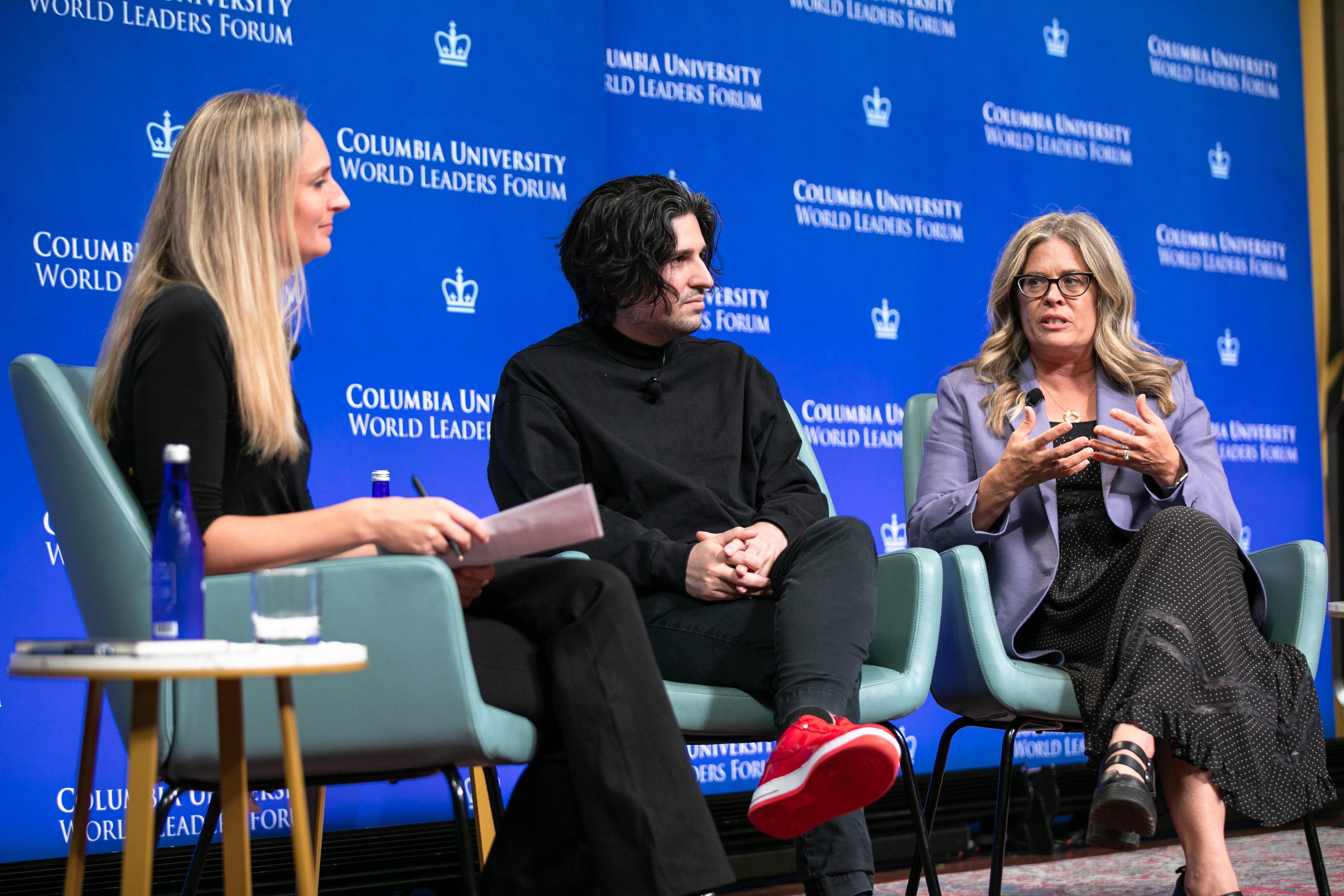
Anastasis, Co-Founder and Co-CEO of Runway, who grew up in Athens and was selected as an Endeavor Entrepreneur in 2025, told that story at Columbia University last month. He shared the stage with Jennifer Lee, the Oscar-winning filmmaker and former Chief Creative Officer of Walt Disney Animation Studios, in a conversation moderated by Lydia Chilton, Associate Professor of Computer Science at Columbia Engineering. The panel was part of AI + Culture, the program Endeavor Greece co-presented with Columbia Engineering and the Columbia School of the Arts under the patronage of UNESCO.
That street showed the founders what Runway would be for. “You can take something very dry and boring, not built at all for creative purposes, and find something interesting in it,” Anastasis said, “as long as you put it in the hands of people who have creative vision.” All three co-founders call themselves failed filmmakers, each having tried to break into film at a different point in life, and Runway became their way back in, a set of tools for people with a vision but without the access or money to put it on screen.
The drawing toy has since grown into a company whose video models are used by Hollywood studios, ad agencies and people who have never worked in film, and increasingly to train robots. At Columbia, Anastasis sat beside the co-director of Frozen, a film that passed through dozens of artists’ hands shot by shot, and the two of them took on what a technology like his leaves to those artists.
What stays with the artist
Jennifer started with a single shot from Frozen 2. The moment Elsa reaches the memory of her mother was animated by a supervising animator named Becky, who had just lost her own mother and asked for the scene. When you watch it, Jennifer said, “you don’t just see love. You see longing, pride, relief, discovery, empowerment,” and all of it comes from Becky. Every shot in films like hers, she added, still passes through 50 or 60 artists.
When Lydia asked what stays scarce once films become cheap to make, Jennifer rejected the word. So many people want to create, she said, that talent has never been the scarce thing. Her worry is that the lone artist could start to feel like “a needle in a haystack” and lose ownership of their work and voice. Asked whether AI can raise our level of creativity, she said, “I’m going to be very candid and say I don’t know.”
Where Jennifer sees talent everywhere, Anastasis thinks the people with the vision to tell great stories will always be rare, and AI will not change that. Technology is good at answering questions, he said, while creativity is “the ability to ask novel questions that haven’t been asked.” What AI changes is who gets to ask them. The average novelist, he pointed out, is less entrepreneurial than the average director and less able to raise the money a film needs, but can now tell a visual story “without necessarily needing to ask for permission.” He expects more forgettable stories as a result, and more remarkable ones, “including a lot of stories that would not otherwise be told.”
A year earlier, Demis Hassabis, who co-founded DeepMind and now chairs Google DeepMind, had predicted much the same. At the 2025 Athens Innovation Summit, which Endeavor Greece hosted with Google Greece, Linda Rottenberg, Co-Founder and CEO of Endeavor, asked him how tools like Runway’s could make creators more powerful. Everyday people would make things easily, he said, while professional artists could explore far more ideas, more cheaply, and then rely on “their judgment and their aesthetic skills” to choose the ones that mattered.
What the machine takes over
If the vision stays with the person, Runway’s job, as Anastasis sees it, is to give that person more control. Traditional computer graphics began with control and worked toward quality, as animators built a scene from basic parts and then rendered it. AI video went the other way, producing striking images nobody could steer, and Runway has spent the past few years putting the steering back. A filmmaker can now load 10 or 50 references for characters and settings, cast a film, explore its world and build it scene by scene, while the model handles chores like rotoscoping, the frame-by-frame tracing that, as he put it, nobody quite enjoyed.
Runway was lifting that chore off artists’ hands before it had released a single video model. Most of the visual effects in Everything Everywhere All at Once, which won Best Picture at the 2023 Oscars, came from a team of five artists. For the scene in which Evelyn and her daughter sit side by side as two rocks, Evan Halleck, one of the film’s visual effects artists, used Runway’s rotoscoping tool to cut the rocks out cleanly while sand and dust blew around them.
Who owns the work
Much of visual AI, someone in the audience pointed out, was built on the work of artists who never consented to it. Anastasis said Runway had pursued data partnerships with studios early on, such as Lionsgate, trading access to their film libraries for tools their own creatives could use. The bigger issue now, in his view, is what the models produce, and Runway has added guardrails to stop people using intellectual property they don’t own.
Asked how artists’ work can be protected, he said most requests to adopt the tools come from artists themselves, and that Runway is one of the few AI companies talking with both the studios and the guilds about protecting artists rather than replacing them. But, he said, “I don’t think we have found all the perfect solutions.”
Whatever the studios and the guilds settle about ownership, the street from that NYU studio still holds the answer. The model behind it had learned everything it knew from driving footage, from real roads where every sign stands exactly where the rules say it should and no one is taller than a full-grown tree. It had never seen a street with a million traffic signs, or pedestrians towering over tiny cars, and it would never have thought to ask for either, until an artist picked up the pen and drew them.