BLOG
Longevity & Healthspan: Can Greece Become a Global Hub for the Future of Health?
By Endeavor Greece
May 12, 2026
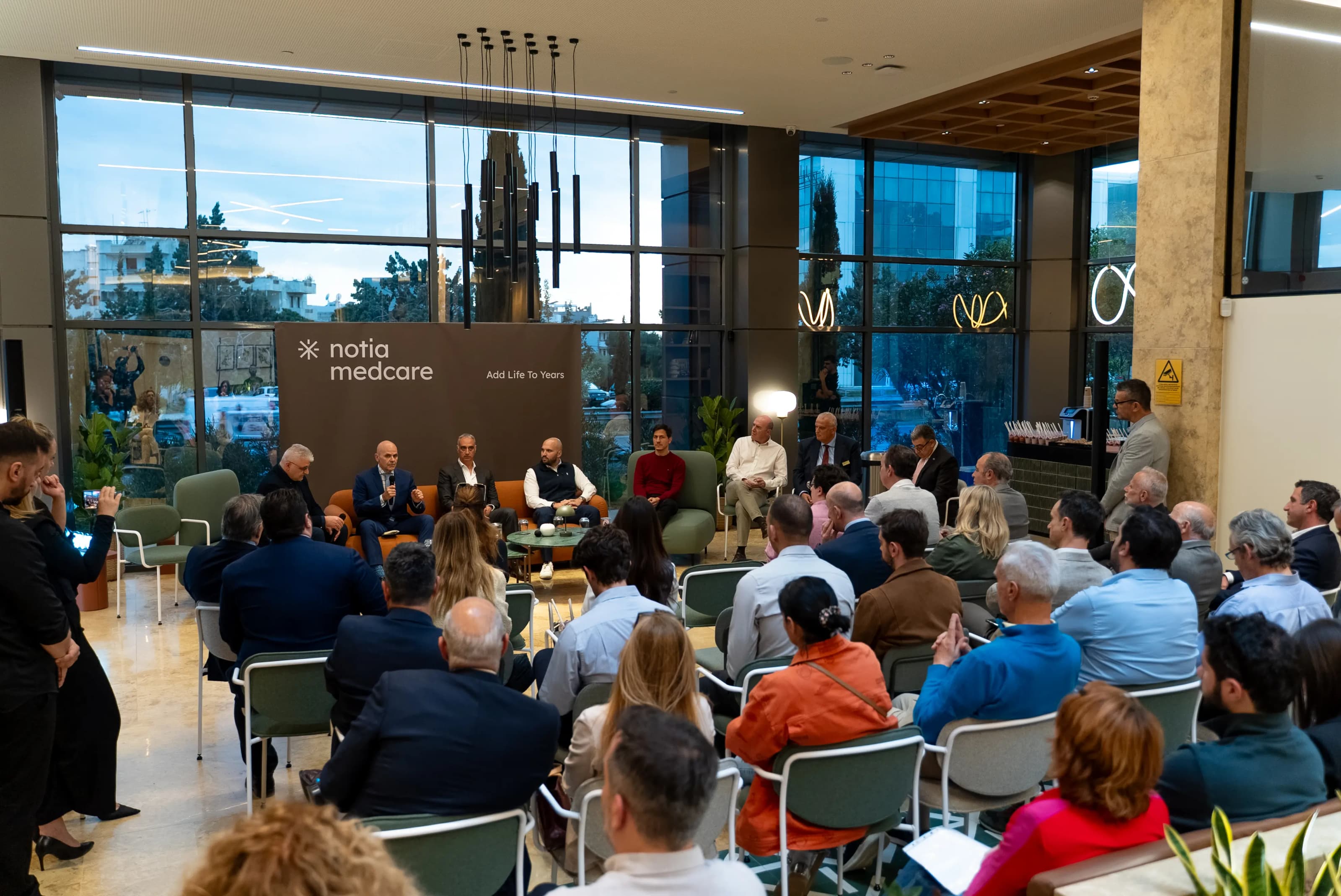
There is a particular kind of conversation that happens when scientists, physicians, founders, and investors sit in the same room and stop performing for each other. Last week at Notia Medcare Longevity Clinic in Glyfada, Endeavor Greece and BioInnovation Greece hosted exactly that kind of evening: a panel on longevity and healthspan that started as a networking event and ended up feeling like the opening pages of a national strategy that nobody has formally written yet.
The discussion, "Longevity & Healthspan: The Future of Health," was moderated by Greg Roumeliotis, Advisory Board Member at Notia Medcare Longevity Clinic and Associate Partner at BioInnovation Greece, with a panel that read like a cross-section of where this field actually lives today:
Nektarios Tavernarakis, Professor of Molecular Systems Biology, Medical School of the University of Crete; Director of IMBB at FORTH
George Paraskevakos, Executive Director, International Probiotics Association
Karim Smaira, Co-Founder and Board Member, Notia Medcare Longevity Clinic
George Varvarelis, Founder & GP, Skybound Ventures; Exited Founder/CEO, Augmenta
John Tsioris, Founder & CEO, Re18; Exited Founder/CEO, InstaShop
Konstantinos Tzoutzourakis, CEO, Notia Medcare Longevity Clinic
Dr. Ioannis Kalaitzis, Chief Medical Director, Notia Medcare Longevity Clinic
What followed was three hours of one of the most clarifying conversations the Greek health ecosystem has had in years.
Medicine Is Catching Up to Aging Itself
For most of the last century, medicine has operated reactively. A symptom appears, a specialist intervenes, a disease is named and managed. Longevity science argues this model is no longer sufficient, not because it doesn't work, but because it's arriving too late.
Professor Tavernarakis framed the scientific pivot with unusual clarity: "Up until very recently, we used to treat each disease individually, cancer, cardiovascular diseases, neurodegenerative diseases, without actually asking what is the underlying cause, what is the ground on which these diseases develop, and what is the linkage to old age." Modern aging research, he explained, treats aging itself as the upstream risk factor, the soil in which most chronic disease grows. "If we are able to sever this link, then we are, as a consequence, going to live longer and healthier lives."
The clinical translation came from Dr. Kalaitzis, drawing on the framework of the Institute of Functional Medicine: "There is the one end that is healthy, the other end is the disease. And in between we have imbalances. And every one of us, almost all of us, are in between." The work of longevity medicine, in his framing, is finding those imbalances early, visceral fat percentages, muscle mass, sleep architecture, hormonal balance, oxidative stress, and correcting them before they become diagnoses.
This is not a small philosophical shift. It changes what a doctor looks for, what a patient pays for, and what a health system measures.
The Demographic Math Nobody Can Outrun
The urgency behind this conversation is not theoretical. George Paraskevakos, who represents 120 member companies across 42 countries through the International Probiotics Association, laid out the demographic reality with the calm of someone who has been watching it approach for years.
By 2030 to 2040, somewhere between a quarter and a half of the global population will be 65 or over. Japan is projected to have half its population over 80 within a decade. A quarter of China's population will be over 65. South Korea's population is projected to halve by 2100 on current birth rates. And while life expectancy continues to climb toward 70 to 71 on average, the WHO has flagged that the final decade is overwhelmingly characterized by chronic illness, exactly the years that healthcare systems cannot afford to subsidize at scale.
His point was uncomfortable but unavoidable: governments cannot pay for trillions of dollars in late-stage treatment for aging populations. "Healthcare systems cannot afford to actually support all the sickness that's going on," he said. The only economically viable answer is prevention, and an IPA socioeconomic study quantified the upside, finding that a 1% improvement in the health of Europeans would generate €10 billion in annual savings.
Paraskevakos was careful to frame what prevention actually requires. "Prevention is very key. It's a lifestyle. It's not a magic bullet. It's a marathon." That framing, he argued, is the one the medical community now needs to embed in how it talks to patients, and the one global research priorities have begun to reflect. "Alongside women's health, longevity is the priority right now in research," he said, pointing to industry investment that has shifted decisively over the past five years from boardroom conversation to active clinical trials.
Without Technology, This Doesn't Scale
If longevity is going to move from a service for the few to infrastructure for the many, the consensus on the panel was that technology has to do most of the heavy lifting.
John Tsioris, who built and exited InstaShop and is now building Re18 in the longevity-infrastructure space, was direct about why this matters: Re18 is building the infrastructure designed to make longevity regimes accessible and affordable at scale, not for the few who can afford a private clinic, but for the majority of the population that will need preventive care in the coming decades.
He named three reasons technology becomes non-negotiable. Scalability, first: clinics serve individuals, but only software serves populations. As the share of people over 65 climbs toward half the global population in the coming decades, no clinical model alone can meet that demand. Scientific currency, second, the pace of new research has outrun what any individual clinician can track. "No physical person, no biological person as of now, can follow and stay up to date," he said. AI paired with seasoned biomedical teams is becoming the only way to keep clinical practice current. And third, the inevitability of AI itself as a layer woven through every part of modern healthcare.
His prediction for the next decade was perhaps the most concrete vision of the evening. "Most of us will have an individualized, highly orchestrated health membership," he said, "every single one of us." A continuous digital health companion monitoring genetic and biochemical biomarkers, paired with AI, telling each person what to do, what's wrong, which clinic to go to, which therapy to take. Companies like Function Health and Superpower are already building it in the US; northern Europe is following; Greece, he noted, is starting. The driving force behind all of it, he reminded the room, is one of the oldest human desires made newly possible: "All of us are here because we want to live longer. Ideally, we want to live forever. Longevity is a driving power in this force."
George Varvarelis brought the investor lens, and a useful reframe of who longevity is actually for: "Ten years ago, the world was synonymous to billionaires who wanted to live forever. But I think this is not accurate." Skybound Ventures doesn't invest in drugs themselves; it invests in the deep-tech infrastructure beneath them. He pointed to one recent example: a UK startup, BioOrbit, manufacturing cancer drugs in microgravity because space-grown crystallization allows certain therapies to be reformulated as injectables, bypassing the worst of chemotherapy. This is the kind of bet, he argued, that defines where longevity capital is actually going.
George Paraskevakos rounded out the technology picture from the research side. AI is now compressing analyses that previously took assays a year, across metabolites, byproducts, and enzymes, into months. Wearables like Oura and Whoop are turning continuous biological signals into translational data. And major philanthropic capital is moving in behind it: the Gates Foundation, the Weston Family Foundation, and others have made healthy aging a top funding priority for the coming decades.
Inside Greece's First Longevity Clinic
The setting for the evening was itself part of the argument. Notia Medcare Longevity Clinic is Greece's first clinic dedicated entirely to longevity and healthspan, and the way it has been designed says something about where the field is heading.
Karim Smaira described the origin almost casually: a personal longevity consultation in South Africa four years ago, a long conversation with a physician who had been practicing the discipline for twenty years, and an instinct that Greece, and specifically southern Athens, needed a healthcare experience that combined clinical seriousness with hospitality-grade service. "There's a lot of firsts tonight," he said, only half-joking. First longevity center in Greece. First event at scale in the facility.
The model itself is built around persona-based protocols. A patient comes in with a specific concern, sleep, perimenopausal hormonal imbalance, focus and chronic fatigue, peak athletic performance, and receives a tailored journey built on diagnostics (biological age, blood work, genetics, family history, stress markers), multidisciplinary specialist input (functional endocrinology, gynecology, orthopedics, regenerative medicine), and a centralized digital interface where results, communication, and progress live in one place.
Konstantinos Tzoutzourakis, the CEO, was direct about what makes Notia Medcare Longevity Clinic structurally different from a conventional private clinic. "The difficult thing is not to build a clinic, but here we define the system," he said. "We're trying to combine traditional medicine with functionality and of course to deliver to the customers the best for their health span." That, in his framing, is why longevity cannot be reduced to a service line: "We cannot say that longevity is a service, but something more than that. It's to make an ecosystem." The operational challenge, he noted, is not any single component, but integrating traditional medicine, functional medicine, advanced diagnostics, hyperbaric oxygen, PEMF, infrared, and AI-driven personalization into a single coherent patient journey where everything connects.
Tzoutzourakis also made the broader point that no clinic, however well-built, can carry the weight of national positioning alone. "It's not the private sector that can do everything," he said. "If you don't have a strategy of that, and of course the government and the public sector to be behind and support it, it's very difficult to accomplish." Greece, he argued, has every structural advantage to become a destination for medical tourism through longevity, excellent doctors and nursing staff, Mediterranean basin, blue zones, climate, euro-zone stability, four to five flight-hours from the UK and the UAE, but the missing piece is national-level commitment to match what the private sector is already building.
Smaira added the cultural condition that has to come with it: "Longevity is a lifestyle choice. Coming once to do a test or to take an IV and then leave will not get you anywhere." It is, in his framing, an integration into daily life, consistency in nutrition, exercise, supplementation, sleep, intervention, not a hack, not a quick fix, not an Instagram trend.
Dr. Kalaitzis pushed the philosophical point further: "Longevity is science. Longevity is medicine. It is not something else."
Greece Is Already a Living Laboratory
This is where the conversation became most distinctly Greek.
Professor Tavernarakis made the case for the country's structural advantages, and the case was stronger than expected. Geography first: Greece sits at the intersection of Europe, the Middle East, and North Africa, a strategic platform for cross-population research collaboration. Then population genetics: isolated island communities (Ikaria, parts of Crete) with documented extreme longevity, plus a population large enough to support meaningful studies and small enough to study feasibly. Then diet and lifestyle: the Mediterranean pattern, still partially intact, still globally recognized. Then human capital: a vibrant research community in basic and applied aging science.
And one advantage that came up later in the evening, raised from the audience by a professor leading a University of Athens spinoff: Greece's botanical chemistry is unique and largely unexplored. Endemic plants in Crete and other regions exist nowhere else on earth. Their compounds, particularly molecules that activate stress-response sensors or selectively clear senescent cells (xenotherapeutics, both xenolytics and xenomorphics), represent an entire pharmacological frontier that hasn't been systematically screened.
In other words: blue zones, biobankable populations, unique chemistry, strong research, Mediterranean cultural reputation, and a euro-zone, EU-regulated economy four to five flight-hours from the UK, the UAE, and most of Eastern Europe.
The case for Greece is not aspirational. It is, on paper, already strong.
The Honest Inventory of What's Missing
The honest part of the evening was the inventory of gaps.
Professor Tavernarakis was unsparing: Greece has no national biobank. No national genomic database of healthy populations. No long-term aging research infrastructure of the kind that the UK Biobank or Finland's whole-population sequencing programs have built. "There is a very large organizational, an infrastructural gap," he said. "We are essentially importers of knowledge and technology," a posture that doesn't work in longevity, because biomarkers, diets, and lifestyles vary by population. Greek research needs to be done on Greek data.
A representative of Thermo Fisher Scientific raised the related and equally critical point that the global aging field still lacks validated clinical biomarkers, and that UK Biobank has begun showing that aging clocks are organ-specific. The opportunity for Greece, Thermo Fisher signaled, would be to build a cohort study sophisticated enough to define organ-specific aging biomarkers in Greek populations. They offered support. The audience took note.
Karim Smaira raised the operational gap. Top-level Greek government is genuinely engaged with foreign direct investment; the middle administrative layer, particularly in the public sector, is slow, opaque, and inconsistent. "There are very unclear processes, timelines, decision-making pathways," he said. As a Greek-speaking entrepreneur, he can navigate it. For international founders and investors, it is often disqualifying.
George Varvarelis named the regulatory gap most sharply. Skybound recently led a €3.8M round into a biotech founded by a Greek scientist at EPFL, and the company chose the US as its primary market because the regulatory pathway to scale is dramatically faster. "It's a disservice to our scientists. It's a disservice to our entrepreneurs to hinder their innovation through regulation." His structural proposal: designate longevity a strategic sector for Greece, on par with how other countries treat AI or space, and ease the path to market.
And Dr. Kalaitzis raised the cultural gap. Longevity, he reminded the room, is not Instagram. "It's not about stopping everything you do and changing everything in your lifestyle just because it is a trend." It is medicine, practiced consistently, over decades. The public mindset shift toward treating prevention as seriously as treatment is, in many ways, the precondition for everything else.
The Window Is Open. Not For Long.
What the evening surfaced, and this is the part worth sitting with, is that Greece is not waiting to be discovered in longevity. The science is here. A first operational clinic is here. The entrepreneurs are here, several of them exited founders now reinvesting their conviction into the space. The research community is here. The patients are here. The geography, the genetics, the chemistry, the cuisine, the climate, all here.
What's missing is the connective tissue. And if there was one conclusion the room kept returning to, in different words from different voices, it was this: Greece's longevity hub needs a national strategy. A regulatory framework that respects the pace of innovation. Biobanking infrastructure built for Greek populations. Public-private investment mechanisms that can carry research from the lab to the patient. And a public willing to commit to prevention as a long arc rather than a quick intervention.
Longevity is no longer a futuristic concept or a billionaires' hobby. It is one of the defining shifts in modern healthcare, and the global capital, scientific attention, and demographic pressure are all converging on it now.
Greece has a narrow, real window to help shape it.
Last week, in one room in Glyfada, the people who could actually do it were all in the same place. The question now is whether the country can build the missing layer fast enough to meet them.