BLOG
No Plane Flies: Greece’s Prime Minister on the Power to Ground AI
By Endeavor Greece
Nov 13, 2026
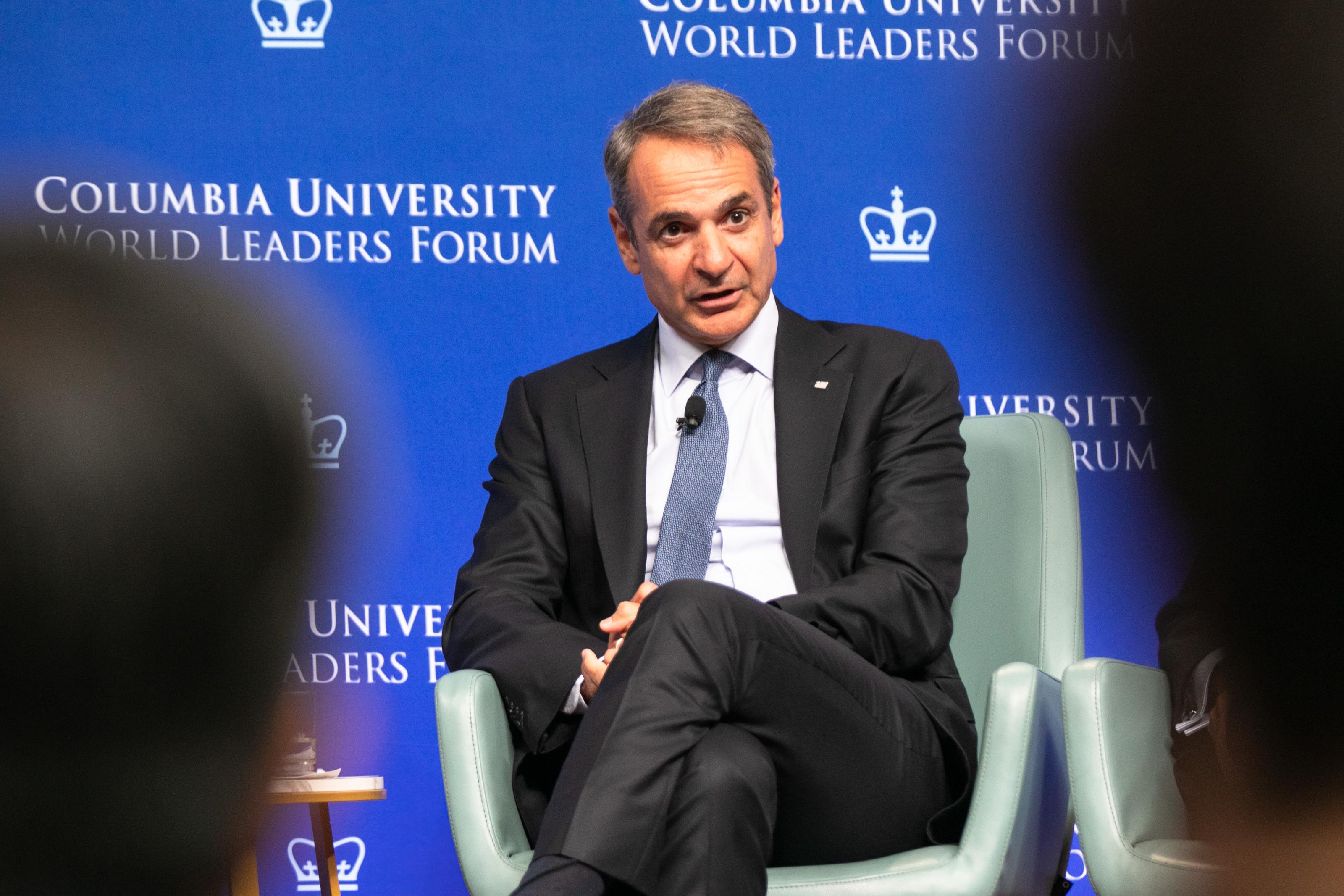
In September 2026, Greece’s Prime Minister was asked at Columbia University what governments can do to protect people’s data from AI. He was speaking at AI + Culture, the program Endeavor Greece co-presented with Columbia Engineering and the Columbia School of the Arts under the patronage of UNESCO, and he answered with an airplane. After an accident, he said, the US Federal Aviation Administration has the power to ground planes, and he imagined what the agency would say. “No plane flies until I figure out what has happened, one year, two years, I don’t care. Safety first.”
Then he turned the image on AI. It is “inconceivable,” he said, that the United States has no regulator looking at AI “from a safety-first perspective,” and leaving the industry to police itself “goes against everything we know about the history of capitalism.” Fareed Zakaria of CNN, who moderated the session the Prime Minister shared with Ajay Banga, President of the World Bank Group, added that AI is the only technology he knows of whose own builders are asking to be regulated while the government answers “let it rip.”
The Prime Minister has been making this case for a year. In September 2025, at the second Athens Innovation Summit, which Endeavor Greece hosted with Google Greece at the Odeon of Herodes Atticus, he shared the stage with Demis Hassabis, who co-founded DeepMind and now chairs Google DeepMind. If AI became a race to build the most powerful model first, the Prime Minister warned, “then there is really no incentive to regulate.”

In an essay in July 2026, Hassabis offered a plan that doesn’t require the race to stop. He proposed a Frontier AI Standards Body, paid for mostly by the industry and staffed by independent experts, that would test the most powerful models before they are released. Washington’s role would be to set it up and oversee it, much as the SEC oversees FINRA, the industry-funded body that polices Wall Street brokers.
With no sign yet of that government-backed body, the labs are now discussing one of their own. Google, OpenAI and Anthropic are reportedly planning a shared standards body based on Hassabis’s model but run by the companies themselves, with no government oversight. At Columbia, the Prime Minister argued for a public one. Because the United States is building the frontier models, he said, it is its job to create “a technocratic regulatory agency” to oversee them.
He is open about how hard that is to get right. Three days earlier in San Francisco, at The Future of AI Elsewhere, the evening Endeavor Greece hosted with Shack15 and The Hellenic Initiative, he admitted he had no clear answer and described three ways policymakers can fail. They can decide AI is too complex and avoid touching it. They can let “the big players end up writing the regulation.” Or, out of fear, they can “hit the brakes far too hard.” What the labs are now discussing comes close to the second.
What Greece already does with AI
The Prime Minister speaks as someone whose government already uses AI. At Columbia, Zakaria asked him how Greece is bringing it into government, and he started with gov.gr, the website where Greeks now get licenses and certificates that once meant hours in line. The next step, he said, is connecting the state’s databases. Opening a gym takes about 16 documents, and the government already holds 13 of them, so a smart system would find those itself, and the applicant would upload the other three and have a permit within an hour. At the national land registry, checking a contract used to take an employee two hours, and an AI tool now does a first review in ten minutes, while “the person is still in charge.”
In May 2026, the government signed a partnership with ElevenLabs so that people can talk to gov.gr instead of typing. The Prime Minister announced it at Panathēnea, the student-run startup festival at the Zappeion, in a conversation with Mati Staniszewski, co-founder and CEO of ElevenLabs, moderated by Panagiotis Karampinis, Regional Managing Director for Europe and Managing Director of Endeavor Greece. He pictured an older woman sorting out her pension with “a smart and friendly AI agent” to walk her through the paperwork. What the state needs, he said, is “a new operating system.”
None of this depends on the most powerful models. It is, he said at Columbia, “very much within the capabilities of what exists right now.” The systems he wants a regulator to watch are the frontier models built by a handful of companies. Banga drew the same line for the developing world. Frontier models need computing power, energy, data, skilled people and capital, he said, and few emerging markets have all five, so their opportunity lies in what he calls small AI. One example is the app the World Bank launched with Google in Uttar Pradesh, which lets a farmer who cannot read photograph a diseased leaf and hear which treatment she needs, for 25 rupees, from her local cooperative. China and America, in Banga’s words, are “the producers of where AI is going,” and the rest of the world are the consumers, who can still choose how to use it.

Who gets the gains
The Prime Minister’s case against an industry policing itself rests on what he calls the history of capitalism. At the 2025 summit under the Acropolis, with Hassabis beside him, he warned that “obscene wealth” concentrated in a few companies would be “a recipe for significant social unrest.” Hassabis agreed that sharing AI’s gains fairly was a question for governments, and said the institutions to do it “probably don’t exist today.”
At the third Athens Innovation Summit, which Endeavor Greece held on the Pnyx in July 2026, the Prime Minister recalled how wealth in the late 19th century piled up in a few giant companies until “the state intervened and broke up companies,” and warned that AI raises the same question “at a different scale.” Hemant Taneja, CEO of General Catalyst, which invests in companies building these systems, put it in an investor’s terms on the same stage. If abundance comes from seven companies, he said, “that’s not abundance.”
At Columbia, the Prime Minister turned to what that scale could mean for work. Picture a bright graduate, he said, who takes out a loan for Columbia Business School and then finds that the consultancies and banks, among the first to put AI to work, need fewer analysts at the bottom of the pyramid. “What happens to the social contract we all signed?” If the valuations of AI companies are right, there must be a huge productivity gain somewhere, and “either the valuations are not correct, or the productivity gain is going to be so massive that it will favor capital at the expense of labor.” His conclusion was that “no government is ready for what will happen in the labor market.”
Banga cautioned that the answer depends on where you stand. The World Bank’s research finds about a third of jobs in rich economies exposed to large language models, single digits in middle-income countries and almost none in low-income ones, so “the filter with which you approach this question is as important as the question itself.”
Zakaria pointed out that tax systems already favor capital, since companies can deduct the full cost of new machines right away and capital gains are taxed more lightly than wages. Asked later by a student how governments could share AI’s gains more widely, the Prime Minister said they do have tools, from how they tax labor and capital to how they deal with very large companies.
Where Greece draws the line
The Prime Minister’s biggest fear is for children. Students who let a machine think for them, he said at Columbia, risk losing skills “at the heart of what makes us human,” and he asked, “What does it mean to have a digital boyfriend or a digital girlfriend?” His advice for schools was to “go back to basics. Read books,” and to keep “taking notes and scribbling in your little book.”
Greece has already acted on part of that fear. At the 2025 summit under the Acropolis, he called children’s use of smartphones and social media “a massive experiment with the mental health of the next generation” and floated a ban below a certain age. Earlier this year, he announced that ban. The bill now before the Greek parliament keeps children under 15 off platforms such as Instagram, Facebook and TikTok, makes the platforms check users’ ages, and allows no parental override. If parliament passes it on 22 October, the ban will take effect on 1 January 2027.
AI companions are his next target. At Panathēnea, with Staniszewski beside him, he drew a line between two uses of the same voice technology. An AI agent that notices a pensioner’s frustration is a service. A companion that gives a teenager “this complete hallucination that you have a relationship” is “simply not acceptable.” It is the principle behind his call to the United States, that a government rather than the companies building a technology should decide where it becomes too risky.
Who decides at the frontier
Two days after Hassabis published his essay, on the Pnyx, Linda Rottenberg, Co-Founder and CEO of Endeavor, asked the Prime Minister whether he thought the United States would build anything like his standards body. He shared Hassabis’s alarm, calling the risk of something going badly wrong “too big to ignore,” but doubted that the United States was “in a mood to put the brakes on these technologies” while it races China. Taneja described the same pressure from inside the industry, where the few engineers who could test models for what might go wrong end up making them smarter instead.
At Columbia, asked what he had changed his mind about in the past year, the Prime Minister said he hadn’t expected the people building the technology to admit “they have no idea how it actually works,” and he expects the next stage to be that “the AI model writes the next AI model.”
A year after the summit under the Acropolis, no one yet holds the power to say no plane flies. The labs are building a body of their own, and the question the Prime Minister keeps asking is whether a government will claim that power first.